
Sep 2, 2026Technical Blog & Machining Tips
What Should You Know Before Buying a Center Cutting Carbide End Mill?
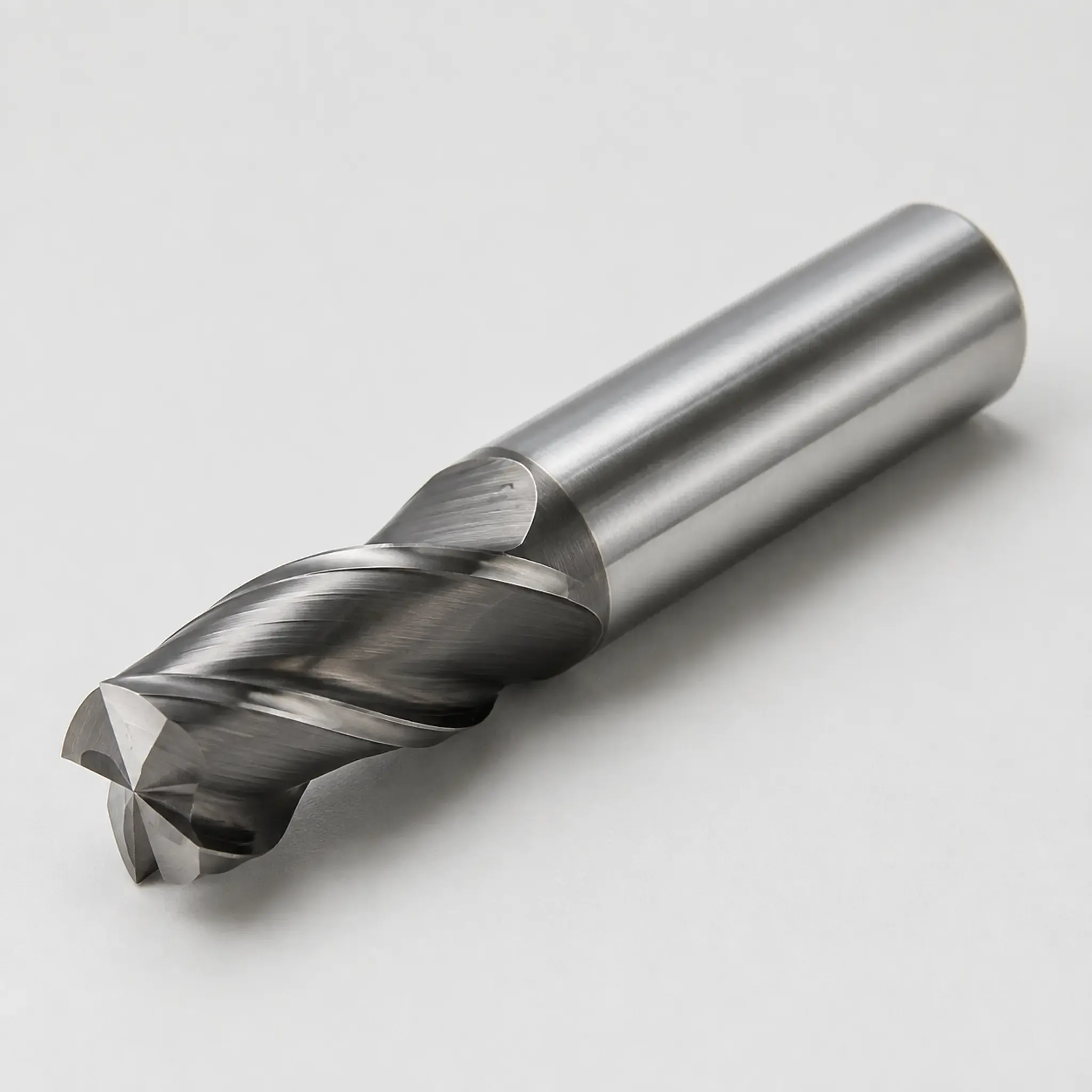
Your team is struggling with inefficient pocketing operations and frequent tool breakages during plunging. These issues aren't just technical headaches; they're driving up operational costs, causing expensive machine downtime, and eating directly into your profit margins. Choosing the right center cutting carbide end mill is a strategic business decision that solves these problems and improves your bottom line.
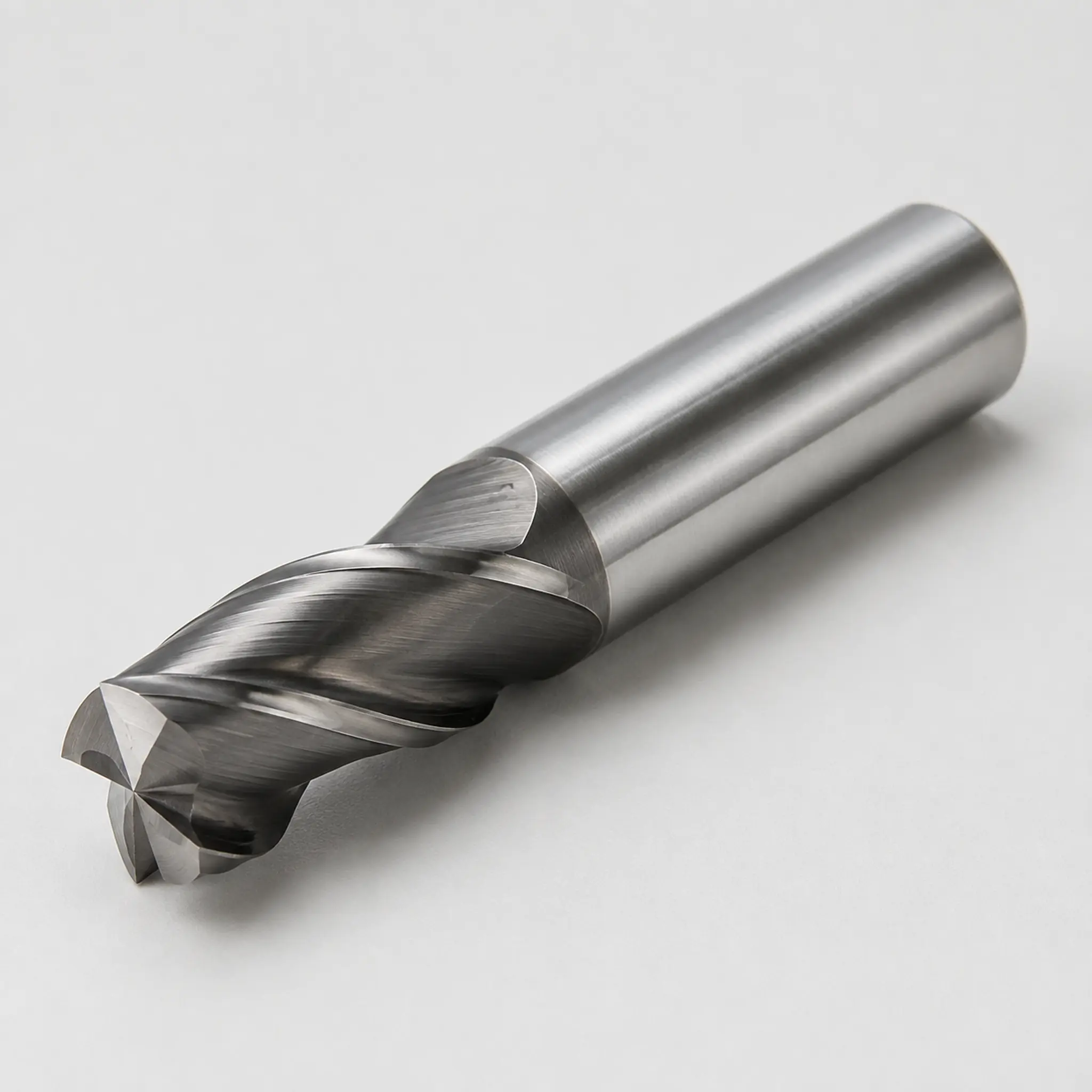
A center cutting carbide end mill has cutting edges that extend to the center of the tool's face, allowing it to plunge directly into material like a drill[1]. This capability is critical for efficient pocketing, slotting, and drilling-style operations[2], enabling more advanced toolpaths that reduce cycle times and overall manufacturing costs.
But how does this single feature translate into real-world cost savings for your business? It’s about much more than just the ability to plunge. Let's explore how making the correct tool choice impacts your entire operation, from your annual tooling budget to your total production capacity.
Is Any Center Cutting Carbide End Mill Good for Plunging?
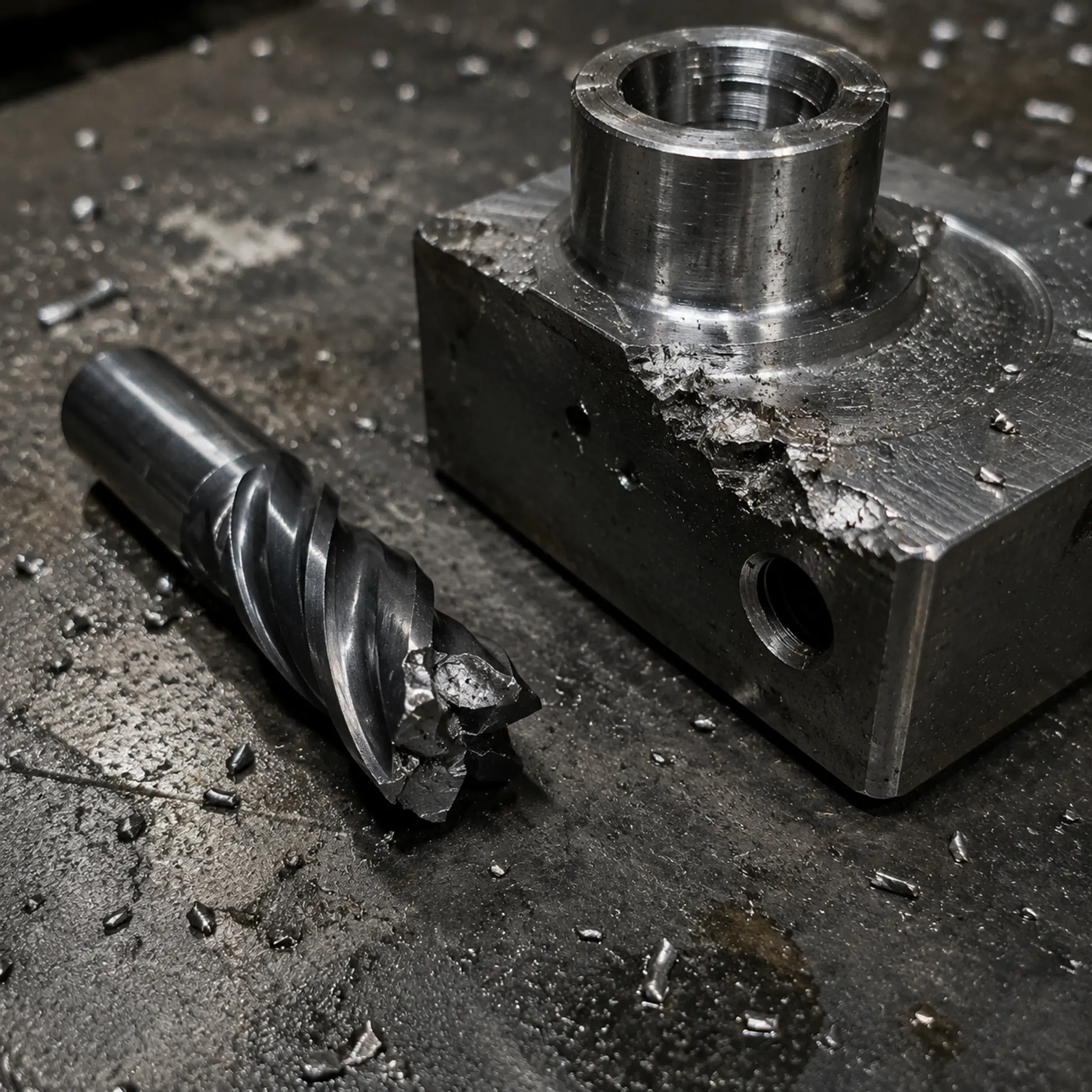
You assume that if a tool is labeled "center-cutting," it can be plunged aggressively without any issues. But then, you get reports from the shop floor: tools are snapping, expensive parts are being scrapped, and a machine is sitting idle, waiting for a replacement. What went wrong?
No, not all center cutting tools are created equal for plunging. Critical factors like flute count, core strength, and specific face geometry determine how effectively and safely a tool can plunge.[3] Using the wrong type for an aggressive plunge is a common and costly recipe for failure.
Dive Deeper
The term "center cutting" simply means the tool can cut at its center axis. It doesn't tell you how well it performs that specific task under pressure. This is a distinction I see cause a lot of financial pain for companies that are new to this type of machining.
Why 'Center Cutting' Isn't a Blank Check for Plunging
The ability of a center cutting carbide end mill to plunge effectively is directly tied to its ability to evacuate chips from the hole it's creating. If chips pack into the flutes, they generate immense heat and pressure, leading to catastrophic tool failure.[4]
Here’s a practical breakdown:
- Two-Flute End Mills: These are the champions of plunging. With only two flutes, there is a massive amount of open space for chips to be cleared away from the cutting zone. This is especially vital in gummy materials like aluminum, where chips can easily weld to the tool.[5]
- Three-Flute End Mills: These offer a good compromise. They can plunge reasonably well while providing a better surface finish and higher feed rates in side milling compared to a two-flute tool. They are a versatile, but not specialized, choice.
- Four-Flute (and higher) End Mills: These are generally poor choices for aggressive plunging. The flutes are much smaller, and the core of the tool is larger and stronger, which is great for profile milling and finishing. However, that design leaves very little room for chips to escape during a plunge cut. They will clog almost instantly, leading to breakage.
I remember a customer who was breaking four-flute end mills while trying to plunge into 6061 aluminum. They were convinced it was a tool quality issue. After a quick call, we realized they were using a finishing tool for a roughing operation. We switched them to a two-flute center cutting carbide end mill from our lineup, specifically designed for plunging in aluminum. The problem vanished immediately. Their machine downtime for that operation dropped to zero, and they stopped scrapping expensive raw material.
The Business Cost of a Bad Plunge
As a procurement manager or business owner, you need to see this not as a technical problem, but as a direct financial risk. The cost of a failed plunge goes far beyond the price of the tool itself.
Let's quantify the real cost:
- Cost of the Broken Tool: The initial expense you see on the invoice.
- Cost of the Scrapped Workpiece: This includes the raw material cost plus all the machine time and labor already invested in the part before it was scrapped. This can often be 10x to 100x the cost of the tool.[6]
- Cost of Machine Downtime: An idle CNC machine costs you money every minute. You're paying operator wages, facility overhead, and losing the revenue that machine should be generating.
- Risk of Spindle Damage: A catastrophic tool failure can send shockwaves through the machine, potentially damaging the spindle bearings[7]—a repair that can cost thousands of dollars and take the machine out of service for days or weeks.
Choosing the right tool for the job is a fundamental part of risk management in a manufacturing environment. A slightly more expensive but correctly specified tool is infinitely cheaper than one that fails.
How Do Technical Specs on a Center Cutting Carbide End Mill Affect My Budget?
You're looking at a supplier's catalog or a technical datasheet, and it's filled with jargon like "AlTiN coating," "variable helix," and "35° helix angle." It's easy to wonder if any of it really matters, or if it's just a way for manufacturers to justify higher prices, making a true cost comparison feel impossible.
Every single technical specification is a direct lever for cost savings or performance gains. A specific coating can increase tool life and reduce your re-order frequency, while a particular geometry can speed up cycle times, increasing your shop's overall production capacity and profitability.
Dive Deeper
At QT TOOLS, part of my job is to translate these technical features into business value for our customers. When a purchasing manager asks me why one tool is more expensive than another, my answer is always focused on their total cost of ownership and return on investment.
Translating Coatings into Dollars and Cents
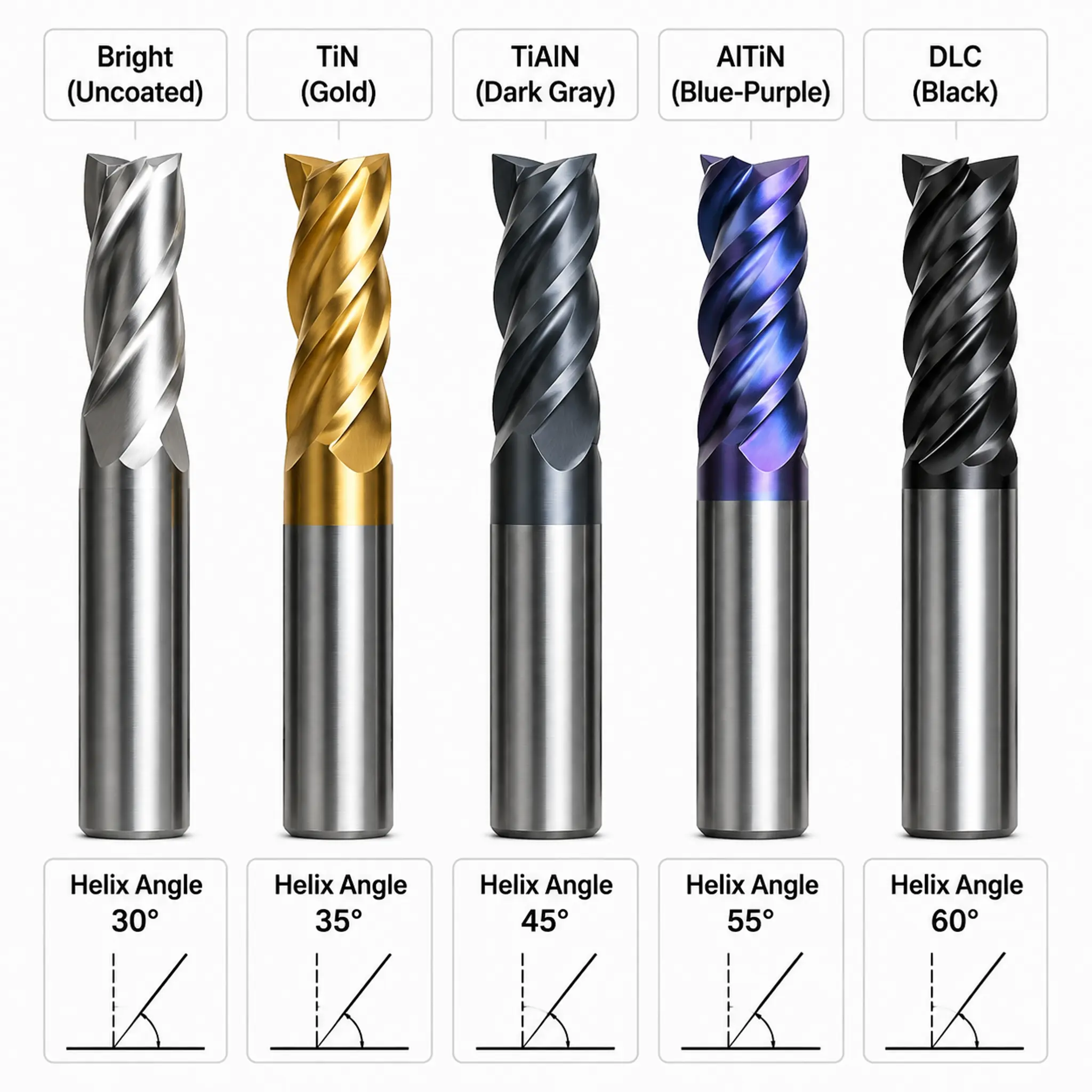
A tool's coating is one of the most significant factors in its performance and price. It's a micro-thin ceramic layer that acts as a shield, protecting the carbide from heat and abrasion.[8] Choosing the right one directly impacts your tooling spend.
Here is how different coatings translate to business benefits:
Coating Type | Primary Application | Direct Business Benefit |
|---|---|---|
Uncoated | Aluminum, Plastics, Wood | Lowest initial purchase price. Ideal for non-ferrous materials where heat is less of a concern. |
TiN (Titanium Nitride) | General Purpose Steels | A good entry-level coating that provides a noticeable increase in tool life over uncoated tools for a small price increase. |
Abrasive Materials, Harder Steels | Offers better wear resistance and hardness than TiN. Allows for higher machining speeds, reducing cycle times. | |
AlTiN (Aluminum Titanium Nitride) | High-Temp Alloys, Stainless, Hardened Steels | Excellent for high-heat applications and dry machining. , dramatically reducing tool changes and annual spend. |
A client of ours was machining 304 stainless steel parts and burning through 10 standard TiN-coated tools per week. The frequent tool changes were killing their production schedule. We introduced them to one of our AlTiN-coated variable helix end mills. They now use just 3-4 tools per week for the same job. That's a 60% reduction in tool consumption and, more importantly, a huge reduction in costly downtime for tool changes. The savings on their annual tooling budget were in the thousands.
How Geometry Drives Profitability
Beyond coatings, the physical shape of the tool—its geometry—is engineered for specific outcomes.
- Helix Angle: This is the angle of the cutting flutes. A higher helix angle (e.g., 45°) evacuates chips more efficiently and provides a better surface finish, which can sometimes eliminate the need for a secondary finishing pass, saving significant time. A lower helix angle (e.g., 30°) creates a stronger cutting edge, making it more durable in tough materials and intermittent cuts, reducing the risk of tool chipping and breakage.
- Flute Count: As discussed, fewer flutes are for plunging and roughing. More flutes (5, 7, or more) allow you to increase your feed rate dramatically during finishing operations without sacrificing surface quality. If you can increase your finishing feed rate by 30%, you are directly reducing the cycle time for every part you make, which means you can produce more parts per day with the same machine and operator.
When we consult on a center cutting carbide end mill, we're not just selling a product. We're providing a solution engineered to lower your cost-per-part.
Is the Most Expensive Center Cutting Carbide End Mill Always the Best Choice?
It's a common and tempting belief in procurement: buy the highest-priced tool on the market to "de-risk" the purchase and ensure quality. But your tooling budget is ballooning, and you're not seeing a proportional return in performance or tool life. Something isn't adding up.
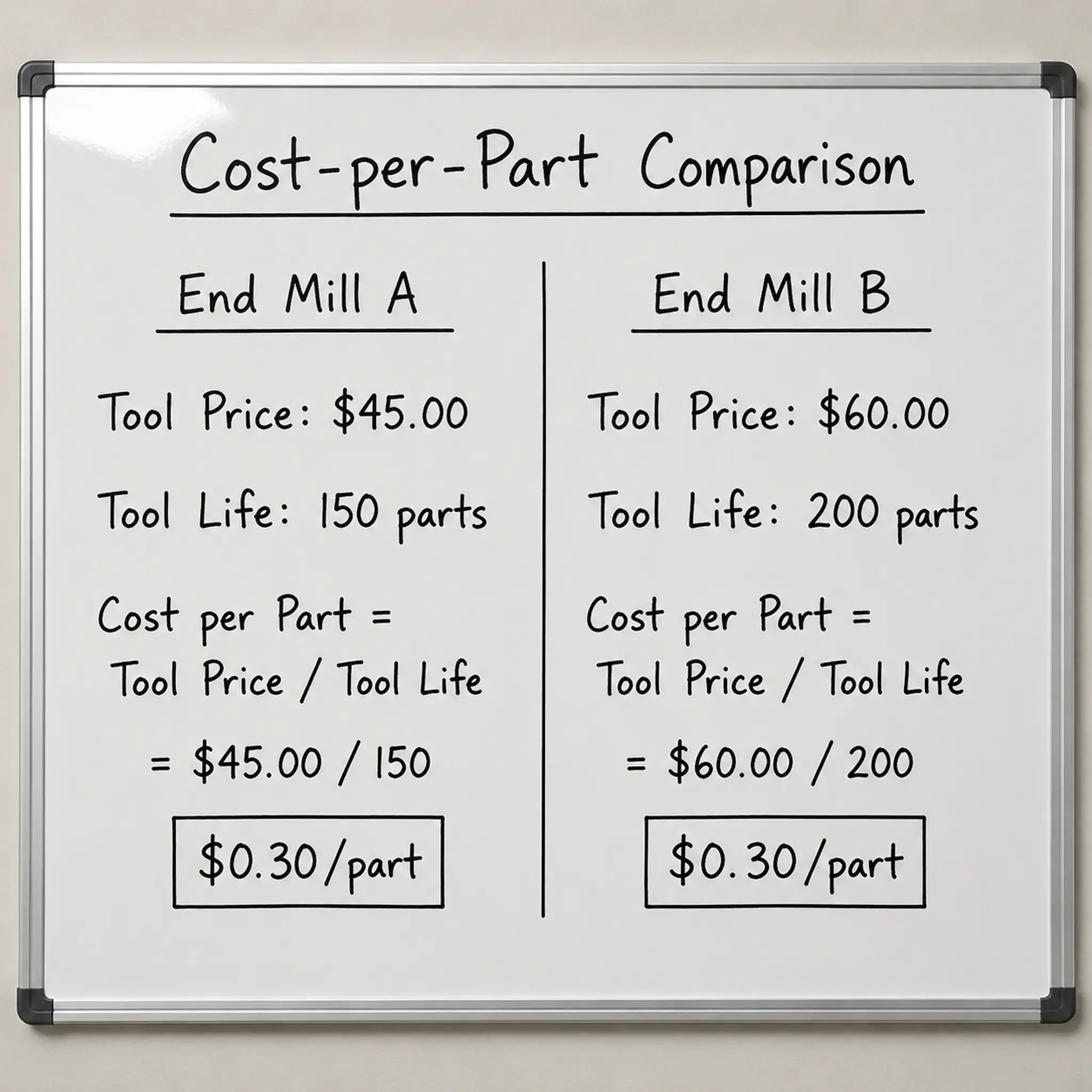
Absolutely not. The "best" tool is the one that is correctly specified for your specific material, machine rigidity, and operation. A moderately-priced, application-specific tool will almost always outperform an expensive, general-purpose one, resulting in a significantly lower cost-per-part.
Dive Deeper
This misconception is one of the most expensive I see in the industry. It stems from a lack of transparency between tooling suppliers and the businesses they serve. The most expensive tool is often a highly specialized solution designed for a narrow range of extreme applications.
The 'Good-Better-Best' Fallacy in Tooling
Many premium, high-cost end mills are engineered for the aerospace or medical industries, intended for machining exotic materials like Inconel or titanium on highly rigid, top-of-the-line 5-axis machining centers. Using one of these elite tools to machine general-purpose 4140 steel on a standard 3-axis VMC is like buying a Formula 1 race car for your daily commute. You simply cannot utilize its full potential, and you've wasted a tremendous amount of money.
The rigidity of the machine, the quality of the tool holders, and the programming strategy all have to be in perfect harmony to extract the value from a premium tool. If any one of those elements isn't optimized, you're paying for performance you can't access.
Case Study: Focusing on Cost-Per-Part, Not Tool Price
I had this exact conversation with a production manager at a shop making hydraulic manifolds. They were proud to be using a premium, European-brand center cutting carbide end mill that cost them 0.85 per part**.
I took a look at their machine, their speeds and feeds, and the material. Based on my experience at QT TOOLS, I recommended one of our end mills specifically designed for steels, featuring an optimized geometry and coating for that exact application. Our tool cost $50.
They were skeptical. How could a cheaper tool compete? We ran a test. With the correct parameters, they achieved 80 parts per tool. On the surface, that looks like a 20% drop in performance. But then we did the math:
- Premium Tool: 0.85 cost-per-part**
- QT TOOLS Application-Specific Tool: 0.625 cost-per-part**
By switching to the right tool instead of the most expensive one, they saved over 26% on their tooling cost for that component. This is the kind of partnership we strive for—finding the most profitable solution for our customers, not just selling them the highest-ticket item.
What Are the Hidden Costs of Not Using a Center Cutting Carbide End Mill?
Your machinists are using complex ramping toolpaths to enter pockets because their standard end mills can't plunge. The process seems to work, but you notice that projects are consistently taking longer than quoted, and the number of tool changes seems high. These are the symptoms of a hidden inefficiency.
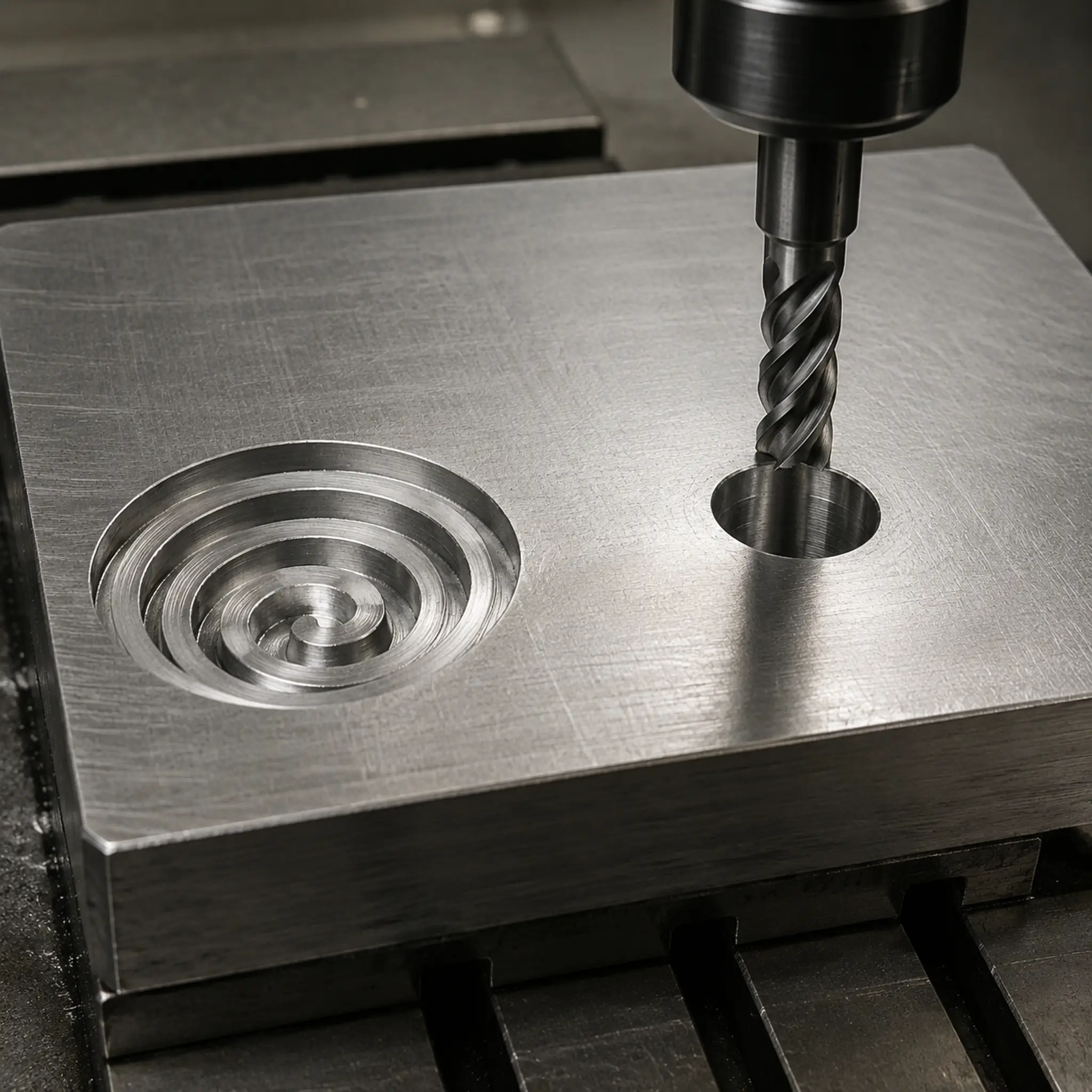
The primary hidden cost of avoiding a plunge is wasted time and complexity. Ramping into a cut takes significantly more machine time and puts different stresses on the tool. This extends cycle times, reduces your shop's capacity, and often forces an extra tool change to drill a pilot hole, adding setup time, cost, and another point of potential failure.
Dive Deeper
In manufacturing, time is money. Any process that can be done more efficiently translates directly to the bottom line. The decision to use, or not use, a center cutting tool is a perfect example of this principle.
Ramping vs. Plunging: A Time and Money Comparison
Ramping—moving into a pocket with a helical or angled motion—is a perfectly valid machining strategy. It's often necessary when using a non-center-cutting tool. However, it's frequently just a workaround for not having the right tool for the job.
Let's look at a simple example:
- Ramping: Entering a 1-inch deep pocket in steel with a helical ramp might take 15 seconds of machine time.
- Plunging: Using a proper center cutting carbide end mill to plunge into the same pocket might take only 2 seconds.
A difference of 13 seconds may not sound like much. But now, let's scale that up for a production run of 10,000 parts. That 13-second difference per part adds up to over 36 hours of saved machine time. I often ask my clients, "What is 36 hours of billable machine time worth to your business?" The answer is usually a very large number.
The Hidden Waste of the 'Drill and Mill' Strategy
Another common workaround is to use two tools: first, a drill to create a pilot hole, followed by a tool change to bring in a non-center-cutting end mill for the pocketing operation. Again, this works, but it's a process loaded with hidden costs that a single center cutting carbide end mill can eliminate.
Consider the costs you are incurring with this two-tool method:
- Cost of the Drill Bit: An additional consumable item for your budget.
- Cost of an Extra Tool Holder: Another piece of hardware that needs to be purchased and maintained.
- Time for a Tool Change: A typical tool change takes anywhere from 30 to 60 seconds. Over thousands of parts, this adds up to hours of non-productive time.
- Increased Programming Complexity: The process is more complex to program and set up, increasing the risk of human error.
- Lost Pocket on the Tool Changer: Using two tools for one feature means you have one less spot in your machine's tool carousel for another job.
By investing in a single tool that can plunge and mill, you are investing in process simplification and efficiency. You remove multiple sources of cost and potential failure, making your entire operation more robust and profitable.
Frequently Asked Questions
How can I tell if an end mill is center cutting?
Look at the end of the tool. If the flutes (cutting edges) go all the way to the absolute center point, it is center cutting. If there is a small hole or an area in the center with no cutting edge, it is non-center-cutting and cannot plunge.
When should I not use a center cutting end mill?
If an operation involves only side milling or profiling, with no plunging required, a non-center-cutting tool may be a more cost-effective choice. They often have a stronger core because the center isn't gashed, which can make them more rigid and durable for heavy side loads.
Does flute count matter for a center cutting tool?
Yes, critically. For aggressive plunging, a 2 or 3-flute tool is best because it provides maximum room for chip evacuation. For finishing operations where you might take a light plunge to start, a 4-flute or higher tool will provide a better surface finish and allow for faster feed rates.
Can a center cutting carbide end mill replace a drill bit?
For some applications, yes. An end mill can create a flat-bottomed hole, which a drill cannot. However, drill bits are optimized for creating deep, straight holes with maximum efficiency. For deep hole-making (typically deeper than 3x the tool diameter), a dedicated drill is almost always the better and safer choice.
Conclusion
Choosing the right tooling is far more than a technical detail; it's a critical business decision that directly impacts your profitability. As we've seen, the "best" tool isn't the most expensive one, but the one correctly matched to your job. Understanding that technical specifications are business metrics in disguise allows you to move beyond price and evaluate total value. By using the right center cutting carbide end mill, you can eliminate inefficient workarounds, reduce cycle times, prevent costly downtime, and ultimately lower your cost-per-part. This strategic approach to procurement turns your tooling from a simple expense into a competitive advantage.
At QT TOOLS, we don't just sell tools; we partner with our clients to solve these business challenges. If you're looking to reduce your tooling costs and improve your bottom line, contact our team for a no-obligation consultation on your specific application.
1
"End mill - Wikipedia", https://en.wikipedia.org/wiki/End_mill. A machining education reference defines center-cutting end mills as tools whose cutting edges reach the center of the end face, enabling axial cutting into the workpiece. Evidence role: definition; source type: education. Supports: The source should define center-cutting end mills and explain that their end geometry permits axial cutting or plunging..
2
"How to Mill a Pocket or a Slot on the Vertical Milling Machine - YouTube", https://www.youtube.com/watch?v=GRL9Pf7STSM. Machining instruction materials identify center-cutting end mills as suitable for operations requiring axial entry, including pocketing and slotting, because the tool can cut at its center. Evidence role: general_support; source type: education. Supports: The source should describe typical operations for end mills and note that center-cutting geometry allows direct entry into material.. Scope note: This supports the general application range, not the economic performance of any particular tool.
3
"Cutting Load Capacity of End Mills with Complex Geometry", https://research.sabanciuniv.edu/231/1/3011800000736.pdf. Manufacturing research on milling cutter geometry shows that flute count, core design, and end-face cutting geometry influence chip evacuation and cutting forces during axial engagement. Evidence role: mechanism; source type: research. Supports: The source should explain how end mill geometry, including flute number and core design, affects chip evacuation, cutting forces, and plunge performance.. Scope note: The source would support the mechanism generally rather than validating every tool design described in the article.
4
"(PDF) New Methods for Tool Failure Detection in Micromilling", https://www.academia.edu/18341365/New_Methods_for_Tool_Failure_Detection_in_Micromilling. Studies of milling mechanics report that poor chip evacuation increases frictional heat and cutting loads, conditions associated with accelerated wear and possible tool breakage. Evidence role: mechanism; source type: paper. Supports: The source should support that inadequate chip evacuation increases cutting temperature, friction, or cutting forces and can accelerate tool wear or breakage.. Scope note: The evidence is mechanistic and may not quantify the exact failure probability for a specific end mill or material.
5
"How To Prevent Built-Up Edge (BUE) When Machining ...", https://www.sansmachining.com/how-to-prevent-built-up-edge-bue-when-machining-aluminum/. Research on aluminum machining describes built-up edge and chip adhesion on cutting tools, supporting the need for effective chip evacuation when machining ductile aluminum alloys. Evidence role: mechanism; source type: paper. Supports: The source should document built-up edge, chip adhesion, or welding tendencies in aluminum machining.. Scope note: This supports the material behavior generally and does not prove that a two-flute end mill is optimal in every aluminum application.
6
"Manufacturing Machinery Maintenance", https://www.nist.gov/el/applied-economics-office/manufacturing/topics-manufacturing/manufacturing-machinery-maintenance. Manufacturing cost models treat scrap as a combination of material value, labor, machine time, and overhead already invested in the part, which can make a scrapped workpiece substantially more costly than the failed tool. Evidence role: general_support; source type: government. Supports: The source should show that manufacturing scrap costs include material, labor, machine time, and overhead, making scrap cost potentially much larger than consumable tool cost.. Scope note: The cited source may support the cost structure rather than the article’s specific 10x–100x range.
7
"What Causes a CNC Spindle to Fail? - Setco", https://www.setco.com/blog/what-causes-a-cnc-spindle-to-fail/. Machine-tool reliability literature identifies abnormal impact loads and crash events as potential contributors to spindle bearing damage and reduced spindle service life. Evidence role: mechanism; source type: research. Supports: The source should explain that impact loads or crashes in machine tools can damage spindle bearings or affect spindle reliability.. Scope note: This supports the risk mechanism, not the probability or repair cost for any individual machine.
8
"The Study of Radius End Mills with TiB2 Coating When Milling a Nickel ...", https://pmc.ncbi.nlm.nih.gov/articles/PMC10057656/. Reviews of hard coatings for cutting tools describe PVD ceramic coatings as thin protective layers that improve wear resistance, oxidation resistance, and thermal performance of carbide tools. Evidence role: mechanism; source type: paper. Supports: The source should describe hard coatings such as TiN, TiCN, or AlTiN as thin layers used to improve wear, oxidation, or thermal resistance of carbide tools.. Scope note: The exact thickness and performance gain vary by coating process, coating composition, substrate, and cutting conditions.
9
"(PDF) Wear resistance investigation of titanium nitride-based coatings", https://www.academia.edu/31578985/Wear_resistance_investigation_of_titanium_nitride_based_coatings. Comparative studies of coated carbide tools report that TiCN coatings can provide higher hardness and improved abrasive-wear resistance relative to TiN under suitable machining conditions. Evidence role: general_support; source type: paper. Supports: The source should compare TiCN and TiN coatings in terms of hardness, wear resistance, or machining performance.. Scope note: Relative performance depends on the workpiece material, speed, coolant use, and coating architecture.
10
"Performance of AlTiN- and AlTiSiN-Coated Carbide Tools ...", https://ui.adsabs.harvard.edu/abs/2025JMEP..tmp.1165R/abstract. Machining studies of AlTiN-coated carbide tools report substantial tool-life improvements in selected hard or high-temperature materials due to improved hot hardness and oxidation resistance. Evidence role: general_support; source type: paper. Supports: The source should report that AlTiN-coated cutting tools can increase tool life in high-temperature alloys, stainless steels, or hardened steels.. Scope note: The article’s “double or triple” figure should be treated as application-dependent rather than a universal result.