
Jul 11, 2026Case Studies & Applications
How to Choose the Right Carbide End Mill for Steel?
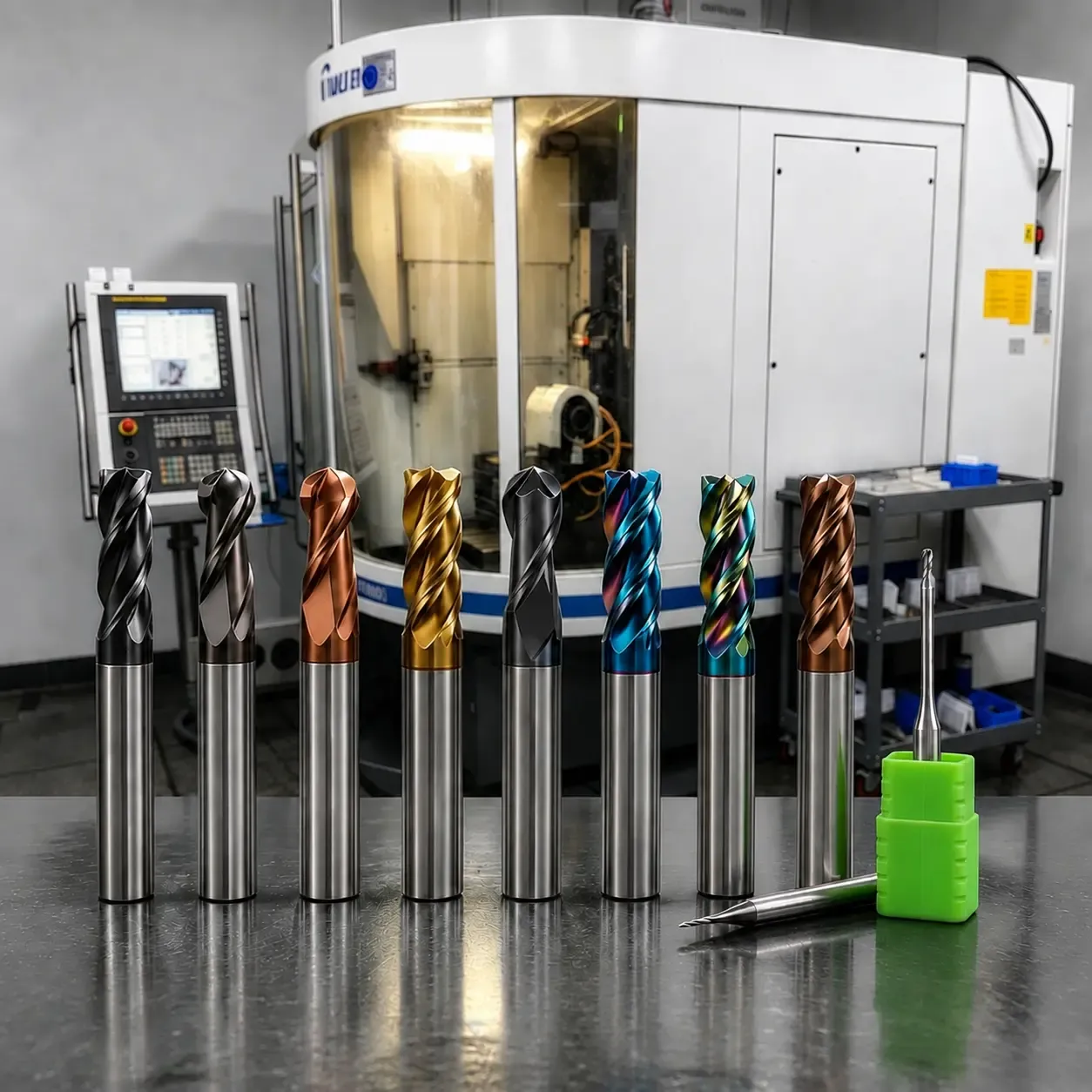
Are you tired of carbide end mills breaking or wearing out too quickly when machining steel? It’s frustrating when a tool fails, causing downtime and scrapped parts, disrupting your entire workflow.
To choose the right carbide end mill for steel, you must first identify the specific steel type (e.g., carbon, alloy, stainless), its hardness, and the machining operation (roughing, finishing). Then, match the tool's flute count, coating, and geometry to these critical factors for optimal performance.
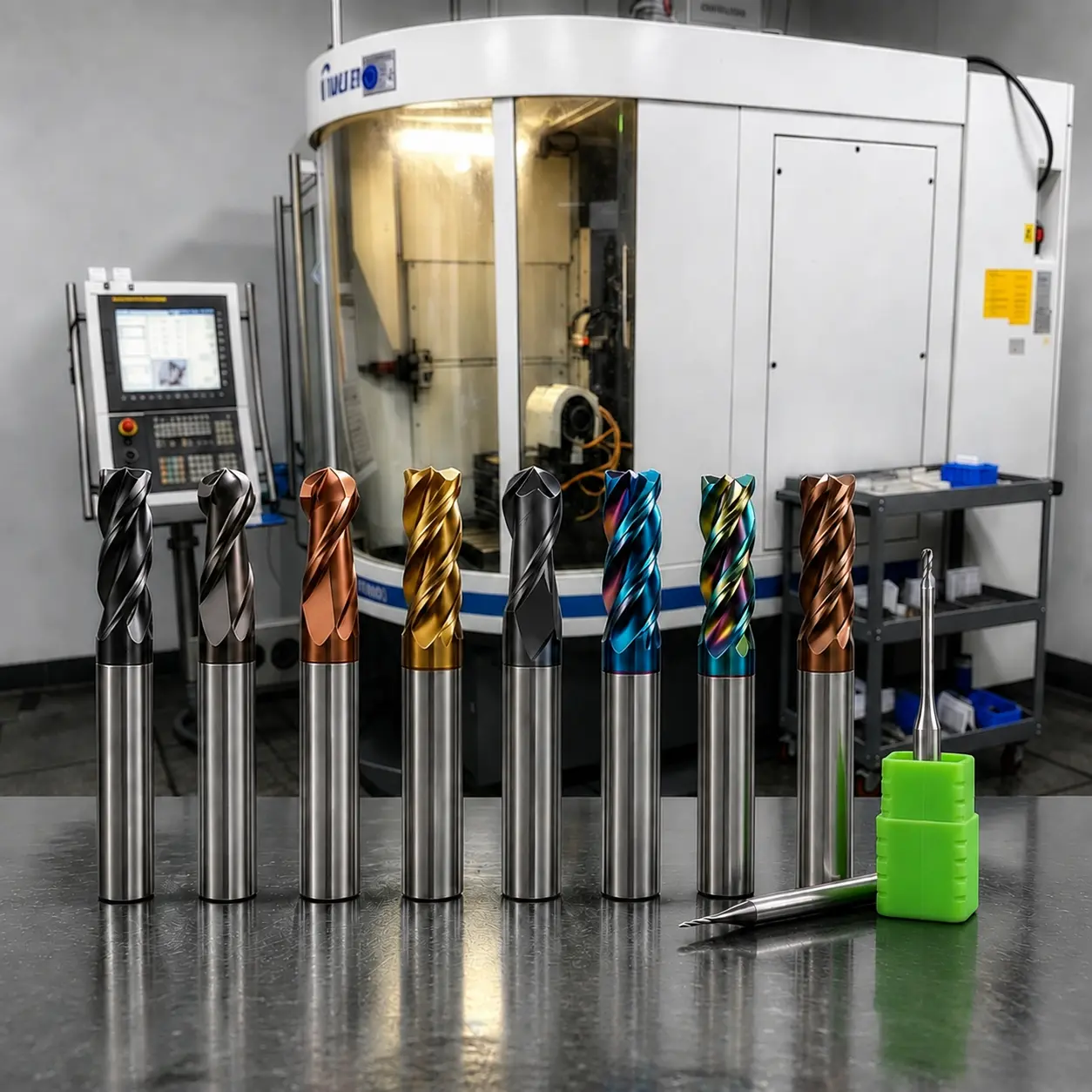
From my experience as a manufacturer, the first question I usually get is, "Do you have an end mill for HRC55 steel?" While hardness is important, it's only one piece of the puzzle. A tool that works perfectly on hardened D2 tool steel might fail spectacularly on a gummy 304 stainless steel of much lower hardness. The secret isn't just matching a number; it's about understanding the entire application. Let's break down how to ask the right questions to get the right tool, every time. This approach will save you time, money, and a lot of headaches.
Why Does Steel Type Matter More Than Just Hardness?
Have you ever picked a generic "steel" end mill, only to watch it fail miserably on a stainless steel job? Now you're left with broken tools and production delays, wondering why.
Steel type matters because different alloys have unique machining characteristics[1]. Carbon steel is abrasive, stainless steel generates high heat and gets sticky, and hardened mold steels require extreme edge strength. Each demands a specific carbide grade, geometry, and coating to manage heat, chips, and cutting forces effectively.
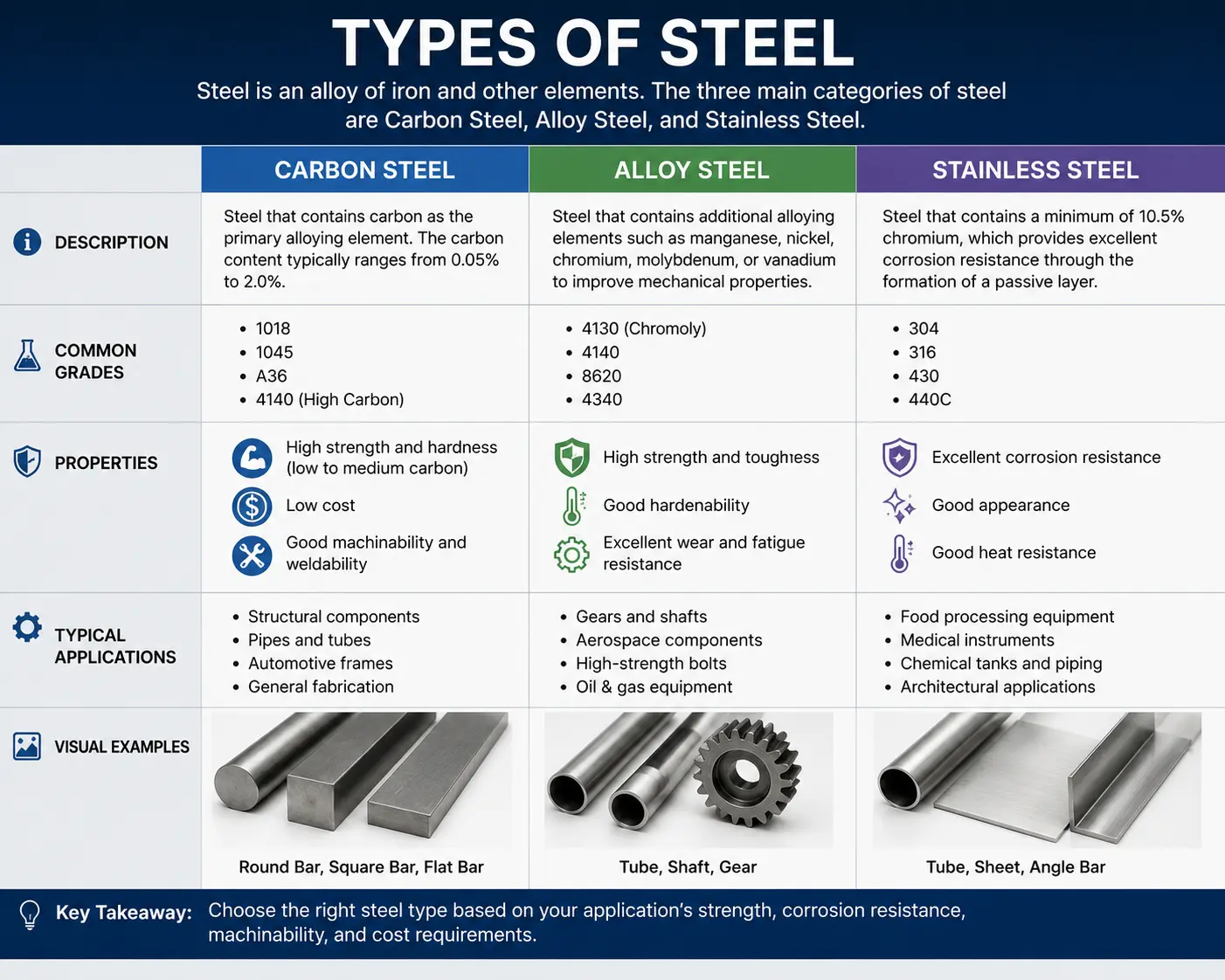
Over the years, I've seen countless customers treat "steel" as a single category. This is the most common mistake. Thinking a tool for 4140 alloy steel will work just as well on 316 stainless is a recipe for failure. They are fundamentally different. Stainless steel work-hardens almost instantly and has poor thermal conductivity[2], meaning all the cutting heat stays right at the tool tip. If your end mill isn't designed for that, it will burn up or suffer from a built-up edge (BUE), where workpiece material welds itself to the cutting edge[3]. Hardened tool steel, on the other hand, acts like glass. It requires a tool with a very strong but sharp edge and a coating that can withstand extreme temperatures and pressure[4]. Understanding these differences is the first step to success.
Here is a simple breakdown I use to guide customers:
Steel Type | Key Challenge | Recommended Tool Focus |
|---|---|---|
Carbon Steel (e.g., 1018, 1045) | Abrasive Wear | A standard, wear-resistant coating like AlTiN. |
Alloy Steel (e.g., 4140, 4340) | Toughness & Heat | Strong cutting edge and a heat-resistant coating. |
Tool Steel (Hardened) (e.g., D2, A2) | Extreme Hardness (>50 HRC) | Tough carbide substrate, strong edge, and advanced coating. |
Stainless Steel (e.g., 304, 316) | Work Hardening & Stickiness | Sharp edge, smooth coating, and excellent chip evacuation. |
How Do Flute Count and Geometry Affect Steel Machining?
Your 4-flute end mill gives a beautiful finish but chatters violently when you try to cut a deep slot. This vibration ruins the part and can even damage your expensive machine spindle.
Matching the flute count to your operation is critical. For steel, use fewer flutes (2-3) for roughing and slotting[5] to create space for large chips to escape. Use more flutes (4-6+) for finishing and side milling[6] to get a better surface finish at higher feed rates.
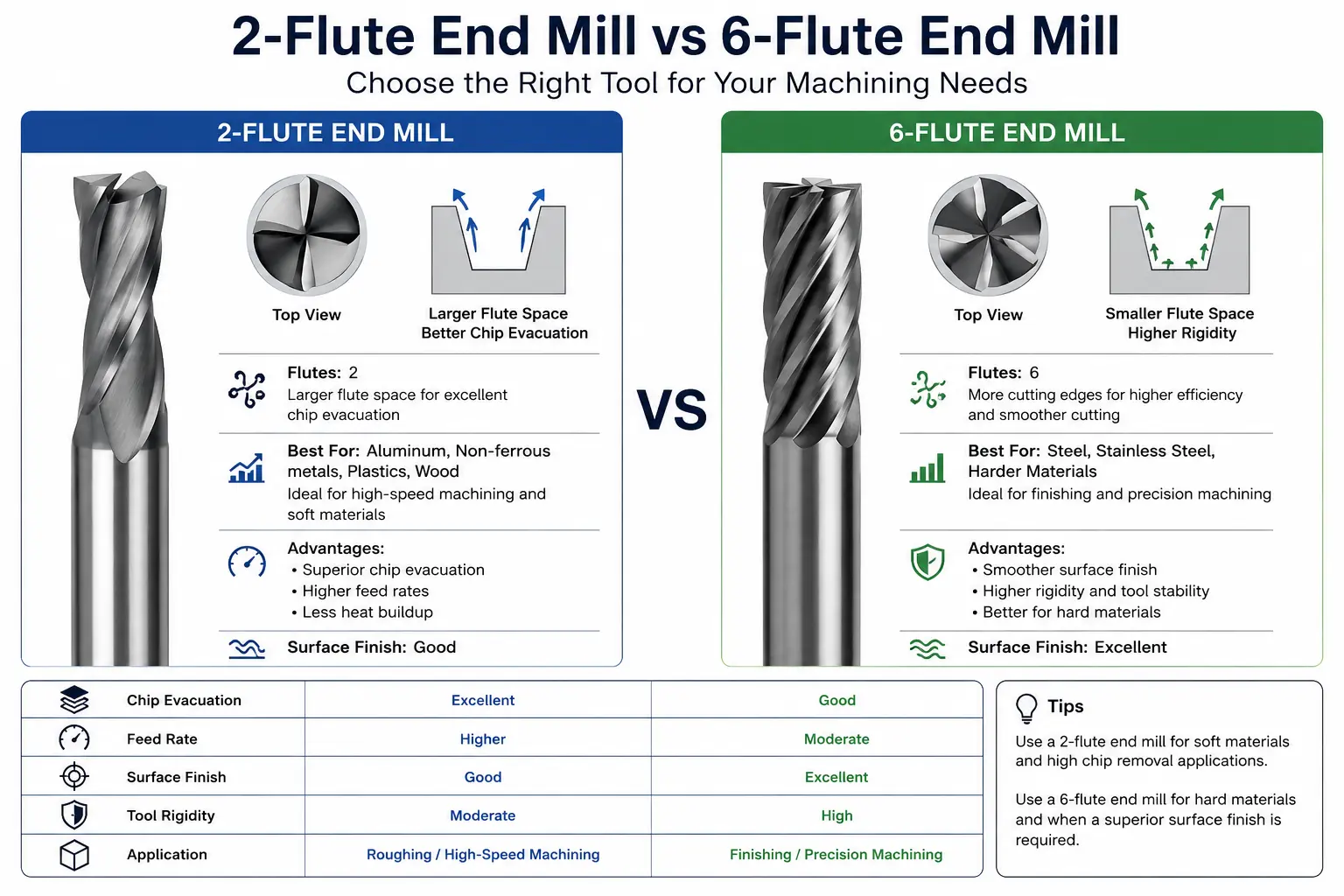
The number of flutes on an end mill directly relates to the size of its "chip gullets"[7]—the empty space between the cutting edges. When you're roughing or slotting, you're removing a lot of material quickly. You need large gullets to get those big chips out of the way. If the chips can't escape, they pack together, causing heat to build up and the tool to break[8]. This is a classic problem I hear about weekly. A customer once tried to use a 7-flute finisher for a deep slot in 4140 steel. The tool snapped within seconds because there was nowhere for the chips to go. We switched them to a 3-flute roughing end mill with deep gullets, and the problem vanished. For finishing, the opposite is true. You're taking light cuts, so chip evacuation is less of an issue. More flutes mean more cutting edges are engaged with the workpiece at any given time, resulting in a smoother, cleaner surface.
This table helps simplify the choice:
Machining Task | Recommended Flute Count | Why It Works |
|---|---|---|
Slotting / Heavy Roughing | 2-4 Flutes | Large gullets are needed to clear a high volume of chips. |
Side Milling / Finishing | 4-6+ Flutes | More cutting edges engaged lead to better finish and stability. |
High-Feed Milling | 4-5 Flutes (Special Geometry) | Allows for shallow depths of cut but very high feed rates. |
Profile Finishing | 6+ Flutes | Provides maximum stability for excellent surface quality. |
Is the Most Expensive Coated End Mill Always the Best Choice?
You invested in a premium, high-tech coated end mill, but it chipped on the very first part. You spent a lot of money for zero benefit and are now questioning your entire purchasing strategy.
Not always. The "best" coating depends entirely on your specific application and machine setup[9]. A super-hard coating like TiSiN is great for hardened steel on a rigid machine but can be too brittle for general-purpose machining where vibration is present. A versatile AlTiN is often a more reliable choice.
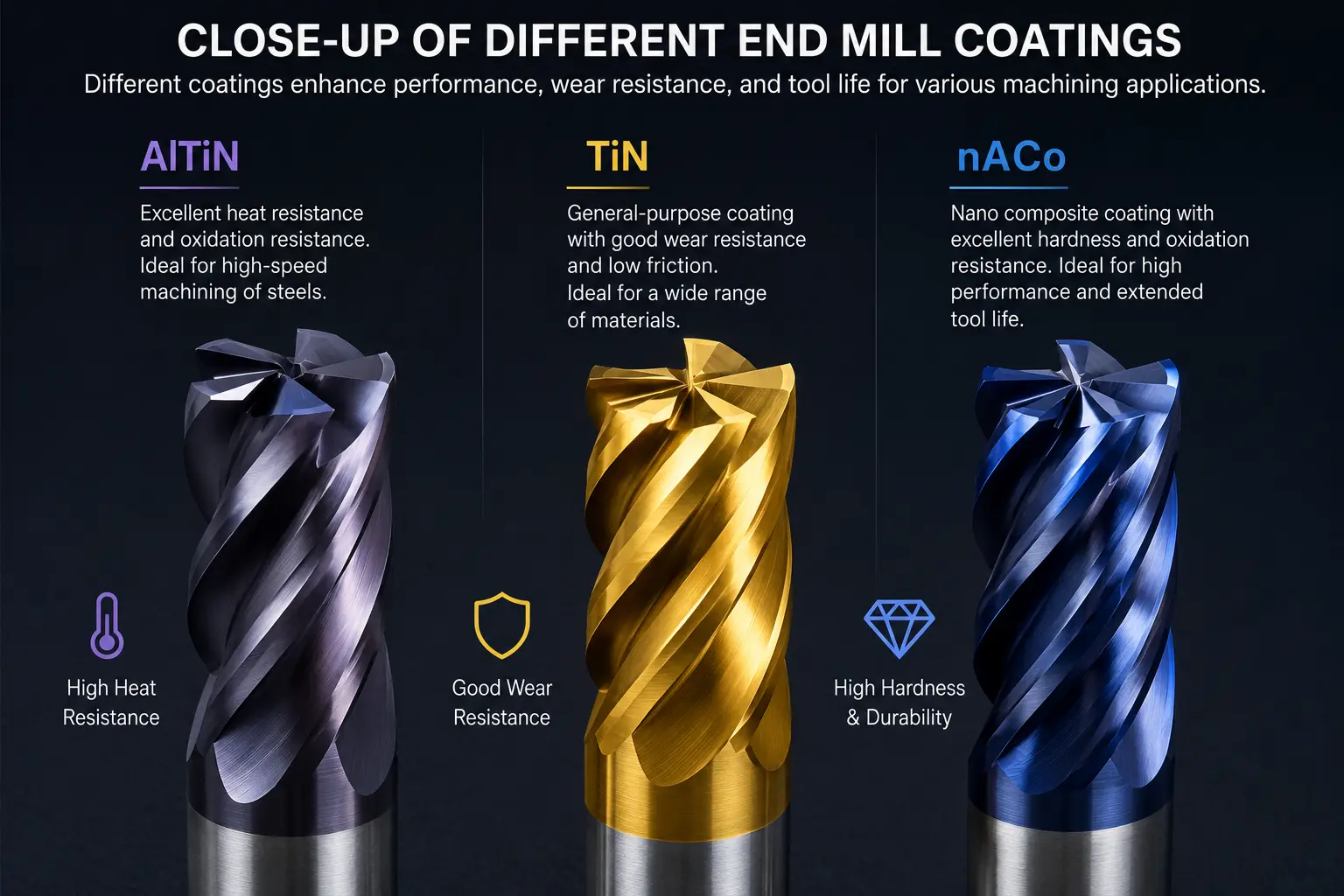
I've seen many shops fall into this trap. They read about a new, advanced coating that promises incredible hardness and heat resistance, so they order it for every job. But these high-performance coatings often trade toughness for hardness. If your machine isn't perfectly rigid or your work holding has some vibration, that brittle coating can easily micro-chip, leading to rapid tool failure. For most general-purpose machining of carbon and alloy steels under 45 HRC, a standard AlTiN (Aluminum Titanium Nitride) coating is fantastic. It forms a protective layer of aluminum oxide at high temperatures, which acts as a thermal barrier[10]. For hardened steels above 55 HRC, a Si-based coating (like TiSiN) becomes necessary to handle the extreme heat[11]. For stainless steels, a smooth, slick coating is more important than a hard one to prevent material from sticking to the tool. The lesson is to match the coating to the job, not just buy the most expensive one on the catalog page.
How Should I Evaluate the True Cost of an End Mill for Steel?
You save money by buying the cheapest end mills on the market. But you're constantly changing tools, fighting inconsistent results, and losing valuable machine time, which completely erodes those initial savings.
Evaluate the true cost by measuring the cost per part, not the cost per tool[12]. A slightly more expensive but reliable end mill that lasts longer will reduce downtime and scrap, resulting in a lower overall cost and a more predictable, profitable operation.

As a manufacturer, I talk to procurement managers all the time. The ones who are most successful don't just look at the unit price of a tool. They look at the total value. Think about it: what’s the real cost of a failed tool? It's not just the price of the tool itself. It's the cost of the machine being idle, the cost of the operator's time to change it, and potentially the cost of a scrapped part. I once worked with a shop that was buying 20 end mills. They were hesitant at first, but our tool consistently produced 200 parts and allowed them to run the machine 15% faster. Their cost per part dropped significantly, and their daily output increased. They stopped seeing tools as a consumable expense and started seeing them as an investment in productivity. For any business running batch production, consistency is everything. A tool that delivers predictable life, run after run, is far more valuable than a cheap tool that gives you a different result every time.
Conclusion
Choosing the right end mill for steel means matching the tool to the specific material and job. Look beyond price and HRC to focus on value, consistency, and reducing your cost per part.
1
"A Study on the Machinability of Steels and Alloys to Develop ...", https://pmc.ncbi.nlm.nih.gov/articles/PMC7559079/. A university or materials-engineering reference should be cited to support that steel machinability depends on alloy composition, microstructure, and heat treatment rather than hardness alone. Evidence role: general_support; source type: education. Supports: Steel machinability varies with alloy composition and microstructure, so steels should not be treated as one uniform machining category.. Scope note: Such a source would provide general materials context, not proof for every specific end-mill choice in the table.
2
"A Historical Review of Cryogenic Mechanical Testing on ...", https://tsapps.nist.gov/publication/get_pdf.cfm?pub_id=959555. A peer-reviewed machining study should be cited to support that austenitic stainless steels commonly exhibit work hardening and low thermal conductivity, conditions that increase heat and tool loading during cutting. Evidence role: mechanism; source type: paper. Supports: Austenitic stainless steels are known for work hardening during machining and for lower thermal conductivity than many carbon steels.. Scope note: The source may discuss common stainless grades such as 304 or 316 rather than every stainless-steel alloy.
3
"Effect of Built-Up Edge Formation during Stable State of Wear ...", https://pmc.ncbi.nlm.nih.gov/articles/PMC5706177/. An engineering encyclopedia or machining reference should be cited to define built-up edge as adhered workpiece material on the cutting edge formed under certain cutting conditions. Evidence role: definition; source type: encyclopedia. Supports: Built-up edge is a recognized machining phenomenon involving adhesion of workpiece material to the cutting tool edge.. Scope note: A definition source would support the phenomenon but not quantify its frequency in any particular stainless-steel operation.
4
"Characterization and Evaluation of Engineered Coating ... - PMC", https://pmc.ncbi.nlm.nih.gov/articles/PMC9415707/. A peer-reviewed hard-milling study should be cited to support that cutting hardened tool steels produces high thermo-mechanical stresses and therefore benefits from strong cutting edges and thermally stable coatings. Evidence role: mechanism; source type: paper. Supports: Hard milling of hardened tool steels imposes high mechanical and thermal loads, making edge strength and heat-resistant coatings important.. Scope note: The source would support the general mechanism, while exact tool geometry still depends on grade, machine rigidity, and cutting parameters.
5
"Why Flute Count Matters - In The Loupe - Machinist Blog", https://www.harveyperformance.com/in-the-loupe/flute-count-matters/. A machining education source should be cited to support that slotting and roughing operations often favor lower flute counts because larger chip spaces help evacuate higher chip volumes. Evidence role: general_support; source type: education. Supports: Slotting and heavy roughing often require greater chip evacuation capacity, which lower-flute-count end mills can provide.. Scope note: The exact number of flutes is application-dependent and may vary with tool diameter, coolant, material, and cutter geometry.
6
"Why Flute Count Matters - In The Loupe - Machinist Blog", https://www.harveyperformance.com/in-the-loupe/flute-count-matters/. A machining study should be cited to support that flute number influences surface finish and cutting stability in end milling, with higher flute counts often suited to light finishing cuts. Evidence role: general_support; source type: paper. Supports: In finishing cuts, greater flute engagement can reduce feed per tooth for a given feed rate and may improve surface quality under suitable conditions.. Scope note: The support is contextual because excessive flute count can be counterproductive when chip evacuation, rigidity, or vibration limits are present.
7
"Do 3-Flute End Mills Really Dominate Aluminum?", https://www.ksptg.com/learning/3-flute-end-mills-aluminum/. An engineering machining text should be cited to support that flute count and gullet volume are linked in end-mill design, affecting the space available for chip evacuation. Evidence role: mechanism; source type: education. Supports: Increasing the number of flutes on a cutter generally reduces chip space between cutting edges for a given tool diameter.. Scope note: The relationship is general because flute shape, helix angle, core diameter, and tool manufacturer design also affect actual gullet volume.
8
"Research on Cutting Force Modeling and Machining Performance of ...", https://pmc.ncbi.nlm.nih.gov/articles/PMC12388261/. A machining research paper should be cited to support that poor chip evacuation can increase frictional heating and chip recutting, which are associated with accelerated wear or tool failure. Evidence role: mechanism; source type: paper. Supports: In milling, inadequate chip evacuation can increase recutting, friction, heat generation, and risk of tool damage.. Scope note: The source may demonstrate the mechanism under selected cutting conditions rather than proving breakage in all slotting operations.
9
"Influence of Nanocomposite PVD Coating on Cutting Tool Wear ...", https://pmc.ncbi.nlm.nih.gov/articles/PMC12073052/. A review article on cutting-tool coatings should be cited to support that no single coating is universally optimal; performance depends on work material, cutting conditions, and the stability of the machining system. Evidence role: expert_consensus; source type: paper. Supports: Reviews of cutting-tool coatings describe coating performance as dependent on workpiece material, cutting temperature, loading, lubrication, and process stability.. Scope note: A review would support the principle but not rank any specific commercial coating for a particular shop.
10
"[PDF] Surface and Coatings Technology Effect of thermal treatments in ...", https://arxiv.org/pdf/1810.05029. A coatings research paper should be cited to support that AlTiN/TiAlN coatings can develop protective alumina-rich surface oxides at elevated temperatures, improving oxidation resistance and reducing heat transfer to the substrate. Evidence role: mechanism; source type: paper. Supports: AlTiN or TiAlN-type coatings can form protective alumina-rich oxide layers at high temperature, contributing to oxidation resistance and thermal protection.. Scope note: The mechanism depends on coating composition, deposition method, temperature, and cutting environment.
11
"Wear behavior and cutting performance of nanostructured ...", https://www.academia.edu/80394464/Wear_behavior_and_cutting_performance_of_nanostructured_hard_coatings_on_cemented_carbide_cutting_tools_in_hard_milling. A peer-reviewed hard-machining paper should be cited to support that TiSiN-type coatings are used in machining hardened steels because their hardness and thermal stability can improve tool performance at elevated cutting temperatures. Evidence role: general_support; source type: paper. Supports: TiSiN and related Si-containing nitride coatings have been studied for hard machining because of their hardness, oxidation resistance, and thermal stability.. Scope note: The source would support suitability, not that TiSiN is strictly necessary for all steels above 55 HRC.
12
"An Expert System Framework for Economic Evaluation of ...", https://drum.lib.umd.edu/bitstreams/9647702c-8d4e-41fe-9270-97e46a71abe7/download. A machining-economics study should be cited to support that tooling decisions are commonly evaluated by total cost per part, incorporating tool life, machine time, downtime, and quality losses rather than tool purchase price alone. Evidence role: general_support; source type: paper. Supports: Machining economics commonly evaluates tool choice through total production cost, including tool life, downtime, cycle time, and scrap, rather than purchase price alone.. Scope note: A cost model would provide general economic support, while actual savings require shop-specific data.