
Jul 28, 2026Case Studies & Applications
How Do You Choose the Right Left Hand Carbide End Mill?
Struggling to find the right tool for your counter-clockwise spindle? Choosing the wrong cutter is more than a simple mistake; it often leads to catastrophic tool failure, scrapped parts, and expensive production downtime[1]. Selecting the perfect left hand carbide end mill isn't about finding a magic bullet, but about methodically matching the tool to your specific setup and application.
To choose the right left hand carbide end mill, you must first confirm your machine has a counter-clockwise spindle. Then, match the tool's geometry—including flute count, helix angle, and coating—to the material you are machining and your primary goal, whether it is aggressive roughing or achieving a fine surface finish. The correct choice is always about application-specific compatibility.

Now that you have the core principle, let's dive into the critical details that separate a successful, profitable machining job from a costly failure. Understanding these nuances is key to making a confident and correct purchasing decision every time.
Why is Directionality So Crucial for a Left Hand Carbide End Mill?
You might be tempted to ask if you can just use a standard, right-hand end mill for your job. This thought, while understandable, ignores the fundamental physics of cutting. The consequences are severe, often involving broken tools and potentially damaged machine components. Let's clarify why direction is completely non-negotiable.
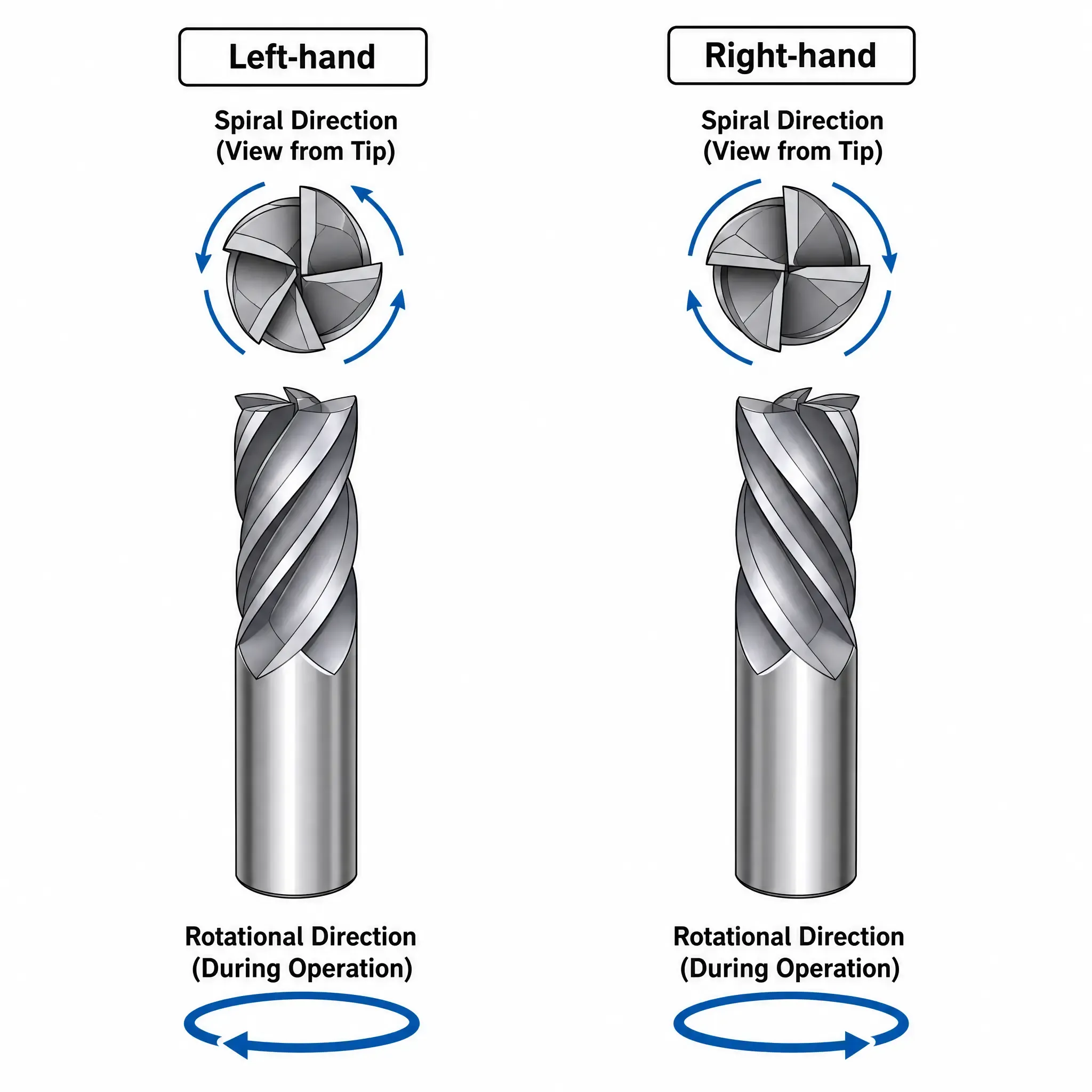
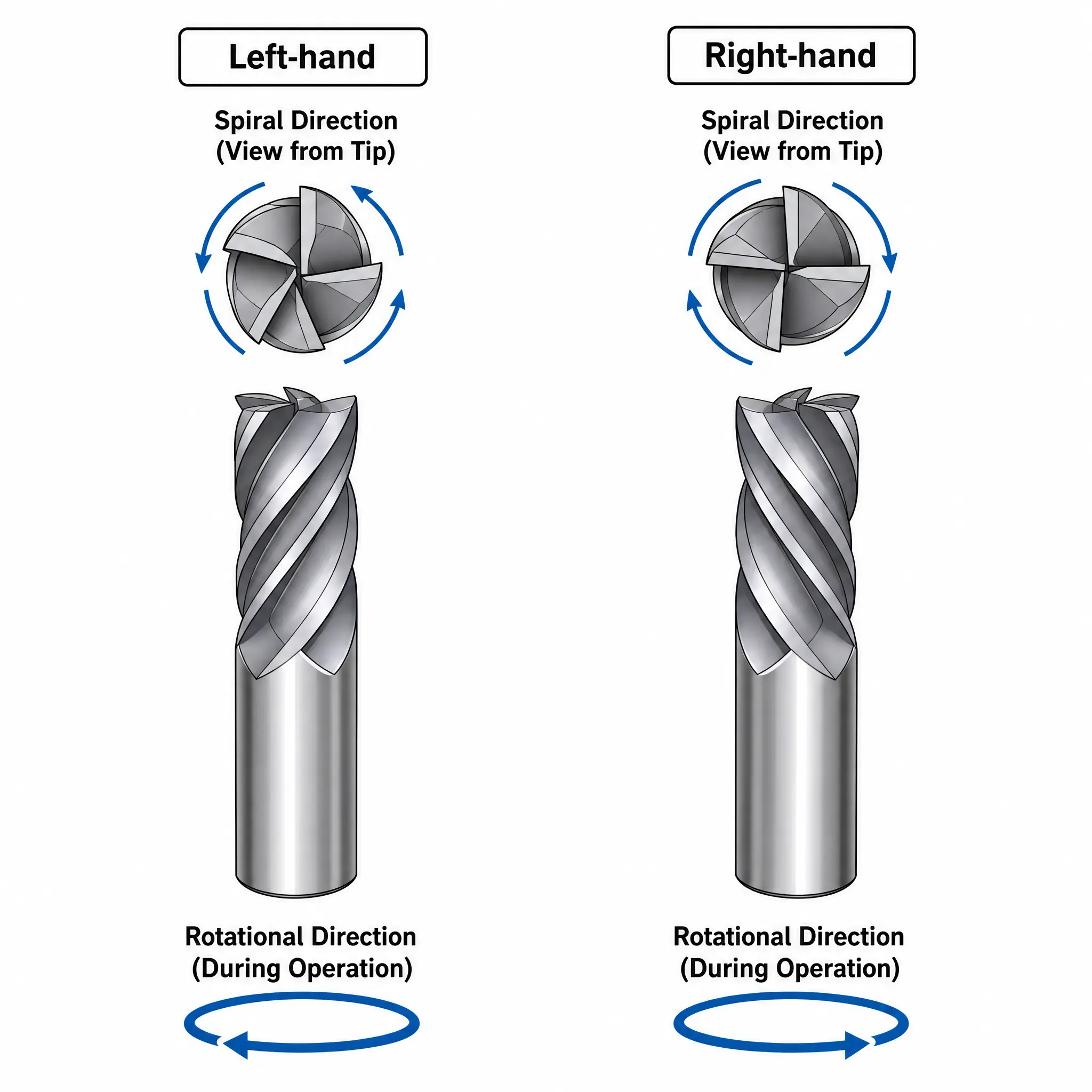
A left hand carbide end mill is designed exclusively for machines with a counter-clockwise spindle rotation[2]. Using this tool on a standard right-hand spindle will cause it to either rapidly unscrew from the tool holder or break instantly upon contact[3], as the cutting forces will work directly against the tool's intended design.
Dive Deeper
In our experience troubleshooting failed jobs, one of the first questions we ask is, "Can you confirm your spindle's direction of rotation?" More often than you'd think, an operator has inadvertently grabbed the wrong tool for a standard machine, or the correct tool for a machine they didn't realize was specialized.
H3: The Physics of Failure
Think about screwing in a standard bolt—you turn it clockwise (to the right) to tighten it. The threads are designed to convert that rotation into axial force. A right-hand end mill works on the same principle. The clockwise rotation of the spindle and the right-hand helix of the flutes work together, pulling the tool securely into the collet and driving the cutting edges into the material.
A left hand carbide end mill does the exact opposite. It is designed to cut effectively when the spindle rotates counter-clockwise. If you place this tool in a standard clockwise spindle, two things happen immediately:
- Cutting edges are running backward. The tool will not slice or shear the material; it will rub and burnish it, generating immense heat and pressure.
- The forces are reversed. Instead of tightening into the holder, the rotational force will actively try to loosen and eject the tool. If it's held tightly enough, the sheer stress on the carbide will cause it to shatter upon impact with the workpiece.
This is a guaranteed failure that is 100% preventable.
H3: Identifying Your Machine
So, how do you know if you need one? Left-hand spindles are not common, but they are essential for certain applications. You'll typically find them on:
- Twin-spindle CNC lathes: The sub-spindle often rotates in the opposite direction of the main spindle[4] to perform secondary operations.
- Dual-spindle CNC routers: In some setups, two spindles run in opposite directions to counteract cutting forces and prevent walking on large gantry systems.
- Custom-built or older machinery: Some specialized machines were designed with counter-clockwise spindles for a specific purpose.
Always check your machine's manual or run the spindle at a low RPM without a tool to visually confirm its rotation (M04 is often the M-code for counter-clockwise rotation, while M03 is for clockwise[5]). Never assume.
What Should You Consider Beyond "Left-Hand" When Selecting the Mill?
You've confirmed you need a left-hand tool, but the job is only half done. Now you're faced with dozens of options for flute count, helix angles, and coatings. Picking one at random is a gamble that rarely pays off, leading to poor surface finish, slow cycle times, or premature tool failure. Let's break down the other vital specs.
Beyond directionality, you must precisely match the flute count, helix angle, and coating to your material and operation. For example, a low flute count is better for chip evacuation in soft materials like aluminum, while a higher flute count is preferred for finishing or cutting harder steels[6].

Dive Deeper
A common question we receive from new clients is, "Just give me your best 1/2 inch left-hand mill." But "best" is relative. The best tool for cutting aluminum is a poor choice for Inconel. The right left hand carbide end mill is the one that is optimized for your specific task. Here's a simplified breakdown.
Feature | Application for Soft Metals (e.g., Aluminum) | Application for Hard Metals (e.g., Steel, Titanium) |
|---|---|---|
Flute Count | 2-3 Flutes (Maximizes space for chip evacuation) | 4+ Flutes (More cutting edges, stronger core, better finish) |
Helix Angle | Variable or Lower Helix (e.g., 30-38°) - Reduces tool pressure and vibration. | |
Coating | Uncoated or specialized (e.g., ZrN, TiB2) - Prevents material from sticking. | Coated (e.g., AlTiN, TiCN) - For heat resistance and wear protection. |
H3: Flute Count and Chip Evacuation
The number of flutes on an end mill involves a critical trade-off.
- Fewer Flutes (2-3): The valleys between the flutes (the "gullets") are very large. This provides ample room for large, gummy chips produced by materials like aluminum to be evacuated efficiently. If you use a high-flute tool in aluminum, the chips can pack into the flutes, leading to recutting, tool breakage, and a terrible surface finish.
- More Flutes (4+): Each flute takes a smaller bite, which generally produces a finer surface finish. The increased number of flutes also adds strength to the core of the tool, making it more rigid and suitable for cutting harder, abrasive materials like steel and its alloys.
H3: Helix Angle, Explained Simply
The helix angle is the angle of the cutting edge as it wraps around the tool.
- High Helix (45°+): Think of this as a very sharp, aggressive slicing action. It's great for pulling chips upward and away from the cutting zone, which is ideal for deep pocketing in aluminum.
- Low Helix (~30°): This is more of a direct, "chopping" action. It creates less upward force, which can be beneficial in thin-walled parts to prevent lifting or chattering. It also provides a stronger cutting edge, which is necessary for tough materials. Variable helix angles are an advanced feature that changes the angle along the flute to disrupt harmonic vibrations[8], leading to smoother cuts in difficult materials.
H3: The Power of the Right Coating
Running a tool uncoated is like sending a soldier into battle without armor. A coating is a micro-thin ceramic layer that dramatically enhances performance. For a left hand carbide end mill, the right coating can:
- Increase Hardness: Protect the cutting edge from abrasive wear.
- Improve Heat Resistance: Act as a thermal barrier, allowing you to run at higher speeds and feeds without degrading the carbide. An AlTiN coating, for instance, forms a layer of aluminum oxide at high temperatures that protects the tool.[9]
- Reduce Friction: A lubricious coating (like TiB2 for aluminum) prevents chips from welding to the tool, ensuring smooth evacuation and a better finish.
Choosing the right coating can double or triple the life of your tool[10], directly impacting your cost-per-part and improving your bottom line.
What Questions Should Your Left Hand Carbide End Mill Supplier Be Asking You?
Are you tired of suppliers who just take your order without understanding your needs? This purely transactional approach often leaves you with a tool that isn't quite right for the job, forcing you to compensate with slow speeds or accept poor results. A true partner helps you succeed by asking the right questions before you buy.
A reliable supplier will act as a consultant, asking about your machine model, the specific material and its hardness, the type of operation you're performing, and your primary goal—be it material removal rate or surface finish. Their goal is to partner in your success, not just to move inventory.
Dive Deeper
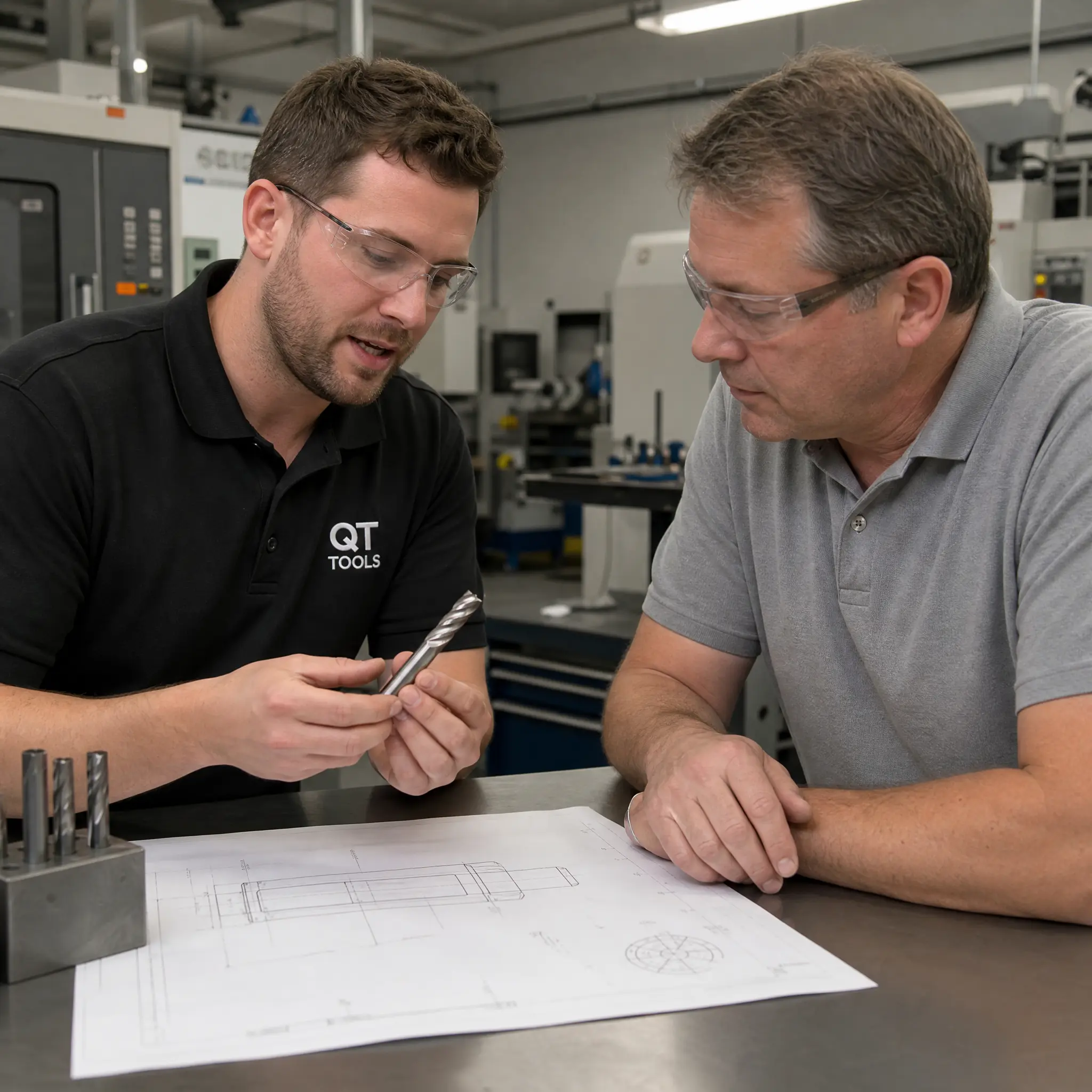
At QT TOOLS, our customer service philosophy is built on partnership. We know that our success is tied directly to yours. When you come to us for a left hand carbide end mill, we don't just point you to a catalog page. We start a conversation. Here are the questions we will ask—and that any reputable supplier should be asking you.
H3: "What Machine Are You Using?"
This is the first and most fundamental question. It immediately confirms the need for a left-hand tool. It also gives us information about the machine's capabilities—its horsepower, torque, and maximum RPM. We can't recommend a tool designed for 20,000 RPM to someone whose machine tops out at 5,000 RPM. This initial question sets the boundary for all subsequent recommendations.
H3: "What Specific Material Are You Cutting?"
"Steel" is not an answer; it's a category. There is a world of difference between machining soft 1018 mild steel and hardened D2 tool steel. The same goes for aluminum—6061 is very different from 7075. In our experience troubleshooting customer issues, the root cause is often a mismatch here. An operator using a general-purpose end mill on a tough, work-hardening material like 316 stainless steel will see extremely short tool life and complain that the tool is "no good." The tool isn't the problem; the application is. A good supplier will ask for the specific grade and even the hardness (HRC) to select the perfect geometry and coating.
H3: "What is Your Goal: Speed or Finish?"
Are you trying to hog out a massive pocket as fast as possible, or are you performing a final pass to hit a tight tolerance and a mirror finish? The tool for each job is different.
- For Speed (High Material Removal Rate): We'd recommend a roughing end mill, possibly with coarse serrations (a "corn cob" rougher) to break up chips, and a geometry that can handle high feed rates.
- For Finish: We'd recommend a finishing end mill with more flutes, a precise corner radius, and a coating that provides lubricity for a clean shear.
A supplier who doesn't ask this question is gambling with your cycle time and part quality. We want to provide the left hand carbide end mill that gives you the competitive advantage you need.
Frequently Asked Questions
Can I use a left hand end mill in a regular drill chuck?
No, this is highly discouraged. A drill chuck is designed for axial loads (drilling), not the high side loads (radial forces) of milling.[11] For a left hand carbide end mill, the counter-clockwise rotation may even cause some drill chucks to loosen. Always use a proper milling holder like a collet chuck or end mill holder.
What happens if I run a left hand carbide end mill too slowly?
If your spindle speed (RPM) is too low for the feed rate, the flutes will rub against the material instead of properly shearing a chip.[12] This creates excess heat, causes rapid tool wear, and can lead to work-hardening of the material surface, making it even harder to cut on subsequent passes.
Is a "down-cut" end mill the same as a left-hand end mill?
This is a common point of confusion, but they are not the same. A "down-cut" or "down-shear" tool typically has a standard right-hand rotation but a left-hand helix. This combination pushes chips downward, which is ideal for cutting laminated materials to prevent top-surface tear-out. A true left hand carbide end mill has both a left-hand rotation and a left-hand helix.
Why are left hand carbide end mills less common and sometimes more expensive?
They are less common simply because the vast majority of CNC machine spindles worldwide are designed for right-hand (clockwise) rotation. Because they are a specialized tool manufactured in lower volumes than their right-hand counterparts, the economies of scale are different, which can sometimes be reflected in the price.
Conclusion
Choosing the right left hand carbide end mill is a process of careful validation and selection. It begins with an absolute confirmation that your machine requires a counter-clockwise tool. From there, it's a matter of partnering with a knowledgeable supplier to systematically match the tool's specifications—its flute count, helix, and coating—to your exact material and operational goals. Never settle for "good enough." The right tool will not only cut your parts correctly but will also improve your cycle times, extend tool life, and ultimately lower your cost per part.
At QT TOOLS, we are committed to being more than just a supplier; we are your partner in productivity. If you're looking for a provider who will take the time to understand your challenges and deliver a tool that gives you a competitive advantage, contact our technical team today. We're here to help you reduce confusion, save time, and improve your bottom line.
1
"Effect of Tool Vibration on Flank Wear and Surface ...", https://www.academia.edu/115745598/Effect_of_Tool_Vibration_on_Flank_Wear_and_Surface_Roughness_During_High_Speed_Machining_of_1040_Steel. A neutral manufacturing-engineering source should be cited to support that inappropriate cutting-tool selection can contribute to tool wear or breakage, defective parts, and production interruptions; such evidence would contextualize the risk rather than prove that every wrong cutter causes catastrophic failure. Evidence role: general_support; source type: research. Supports: Tool selection and cutting-parameter errors are recognized contributors to machining defects, tool failure, and production losses.. Scope note: Contextual support; the source may discuss machining failures generally rather than left-hand carbide end mills specifically.
2
"MILLING OPERATIONS TYPES OF MILLING MACHINES", https://uhv.cheme.cmu.edu/procedures/machining/ch8.pdf. A machining textbook or university manufacturing reference should be cited for the definition that left-hand end mills are configured to cut under counter-clockwise spindle rotation. Evidence role: definition; source type: education. Supports: Left-hand cutting tools are specified for counter-clockwise rotation, in contrast to standard right-hand tools..
3
"Compensation for Deflection of Miniature Milling Tools", https://pec.ncsu.edu/research/compensation-for-deflection-of-miniature-milling-tools/. A machining-process reference should be cited to explain that an end mill operated opposite its intended cutting direction will rub rather than cut and may experience abnormal forces leading to slippage or fracture; direct evidence for immediate breakage in all setups may be limited. Evidence role: mechanism; source type: education. Supports: Incorrect cutter rotation can prevent proper cutting action and create forces that increase the risk of tool slipping, loosening, or fracture.. Scope note: The source may support the mechanism of failure but not the article’s stronger wording that breakage occurs instantly.
4
"LATHE SERIES", https://web.mae.ufl.edu/designlab/TA/Manuals/Haas%20SL-10%20Programming%20Workbook.pdf. A manufacturing-engineering or CNC-machine reference should be cited to support that main/sub-spindle lathes can be configured for opposing spindle rotation during secondary operations; the source may describe common configurations rather than establishing that this is universal. Evidence role: general_support; source type: education. Supports: Twin-spindle or main/sub-spindle CNC lathes may use opposing spindle orientations or rotation directions for secondary machining operations.. Scope note: Contextual support; machine configurations vary by builder and control settings.
5
"CNC Programming for Beginners: Your Step-by-Step Guide ...", https://imba.missouri.edu/cnc-programming-for-beginners-1413580477.html. A CNC programming standard or government technical reference should be cited for the convention that M03 commands clockwise spindle rotation and M04 commands counter-clockwise spindle rotation. Evidence role: definition; source type: government. Supports: Standard CNC G-code conventions assign M03 to clockwise spindle rotation and M04 to counter-clockwise spindle rotation..
6
"Helical - MACHINING GUIDEBOOK", https://web.mae.ufl.edu/designlab/Advanced%20Manufacturing/Helical_Machining_Guidebook.pdf. A machining education source should be cited for the relationship between end-mill flute count, chip evacuation in aluminum, and the use of higher flute counts for finishing or harder materials. Evidence role: mechanism; source type: education. Supports: Flute count affects chip space, chip evacuation, tool rigidity, and finish quality in milling..
7
"The influence of end mill helix angle on high performance ...", https://www.academia.edu/102276120/The_influence_of_end_mill_helix_angle_on_high_performance_milling_process. A machining reference should be cited to support that high-helix end mills tend to shear more aggressively and move chips axially away from the cut, especially in soft or gummy materials. Evidence role: mechanism; source type: education. Supports: Higher helix angles in end mills increase axial chip evacuation and alter the cutting action..
8
"Chatter Stability of Machining Operations Dedicated to S.A. Tobias ...", https://academy.cba.mit.edu/classes/computer_machining/chatter.pdf. A peer-reviewed machining-dynamics study should be cited to support that variable-helix cutter geometry can suppress or reduce chatter by altering the periodic excitation of the milling process. Evidence role: mechanism; source type: paper. Supports: Variable-helix or variable-pitch milling cutters can reduce regenerative chatter and vibration by varying tooth engagement timing..
9
"(PDF) Oxidation post-treatment of hard AlTiN coating for ...", https://www.academia.edu/19791076/Oxidation_post_treatment_of_hard_AlTiN_coating_for_machining_of_hardened_steels. A peer-reviewed coating or cutting-tool materials study should be cited to support that AlTiN/TiAlN coatings may form a protective aluminum-oxide layer at elevated temperatures, improving oxidation resistance. Evidence role: mechanism; source type: paper. Supports: AlTiN or TiAlN tool coatings can develop a protective alumina-rich oxide scale under high-temperature oxidation conditions..
10
"3 Ways Tool Coatings Increase Tool Life - In The Loupe", https://www.harveyperformance.com/in-the-loupe/3-ways-tool-coatings-increase-tool-life/. A comparative tool-life study should be cited to support that appropriate coatings can substantially extend cutting-tool life; any two- to three-fold improvement should be tied to the tested material, coating, and cutting parameters. Evidence role: statistic; source type: paper. Supports: Coated carbide tools can show substantial tool-life improvements over uncoated or mismatched coatings under specific cutting conditions.. Scope note: Quantitative gains are application-specific and may not generalize to all left-hand carbide end mills or machining conditions.
11
"Upright Mill Use Did You Know", https://hydrogen.wsu.edu/2017/09/11/upright-mill-use-did-you-know/. A machine-tool or manufacturing-lab reference should be cited to support that drill chucks are designed for drilling loads and are generally inappropriate for milling because end mills impose substantial radial forces. Evidence role: mechanism; source type: education. Supports: Drill chucks are intended primarily for axial drilling loads, while milling requires holders capable of resisting radial cutting forces..
12
"Children's Health Insurance Program (CHIP)", https://www.medicaid.gov/chip. A machining fundamentals source should be cited to support that inadequate chip load or mismatched speed and feed can cause cutter rubbing rather than proper shearing, increasing heat and tool wear. Evidence role: mechanism; source type: education. Supports: Improper feed and speed combinations can reduce effective chip formation and cause rubbing, heat generation, and tool wear..