
Sep 1, 2026Technical Blog & Machining Tips
Carbide vs Cobalt End Mill: Which is the Right Choice for Your Bottom Line?
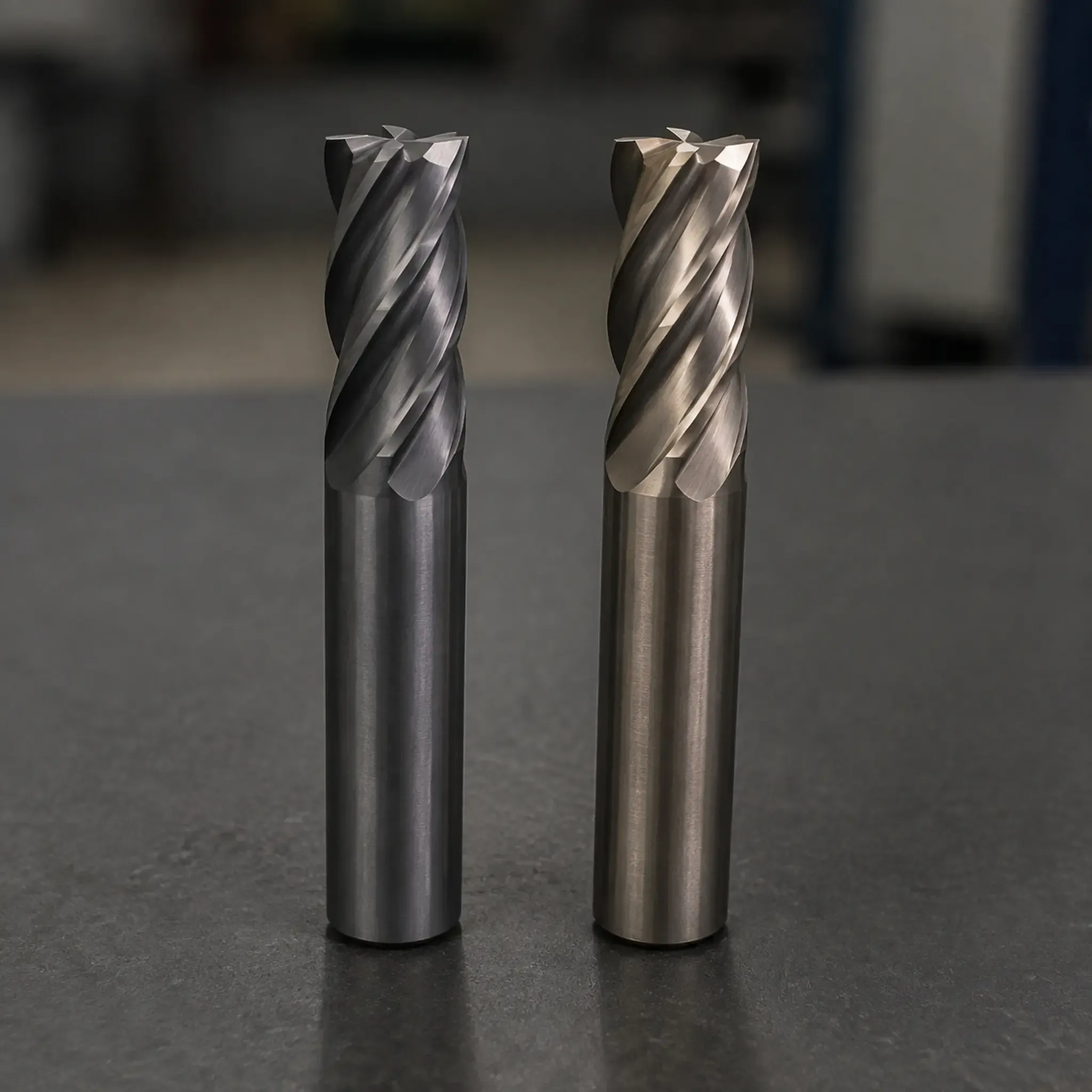
Struggling with the choice of a carbide vs cobalt end mill? Your team wants to boost productivity with "better" tools, but you might be seeing an unexpected rise in tool breakage and production halts instead. These disruptions can end up costing you more than the old tools ever did, wrecking your budget and threatening delivery schedules. The solution lies in understanding that this debate is less about the tool's material and more about matching it to your operational reality to protect your total cost of ownership.
Solid carbide end mills offer superior hardness and heat resistance, making them ideal for high-speed machining on rigid, modern CNC machines.[1] Cobalt HSS (High-Speed Steel) end mills provide greater toughness and are more forgiving, making them the cost-effective and reliable choice for older machines, less-rigid setups, or applications with heavy vibration or interrupted cuts.[2]
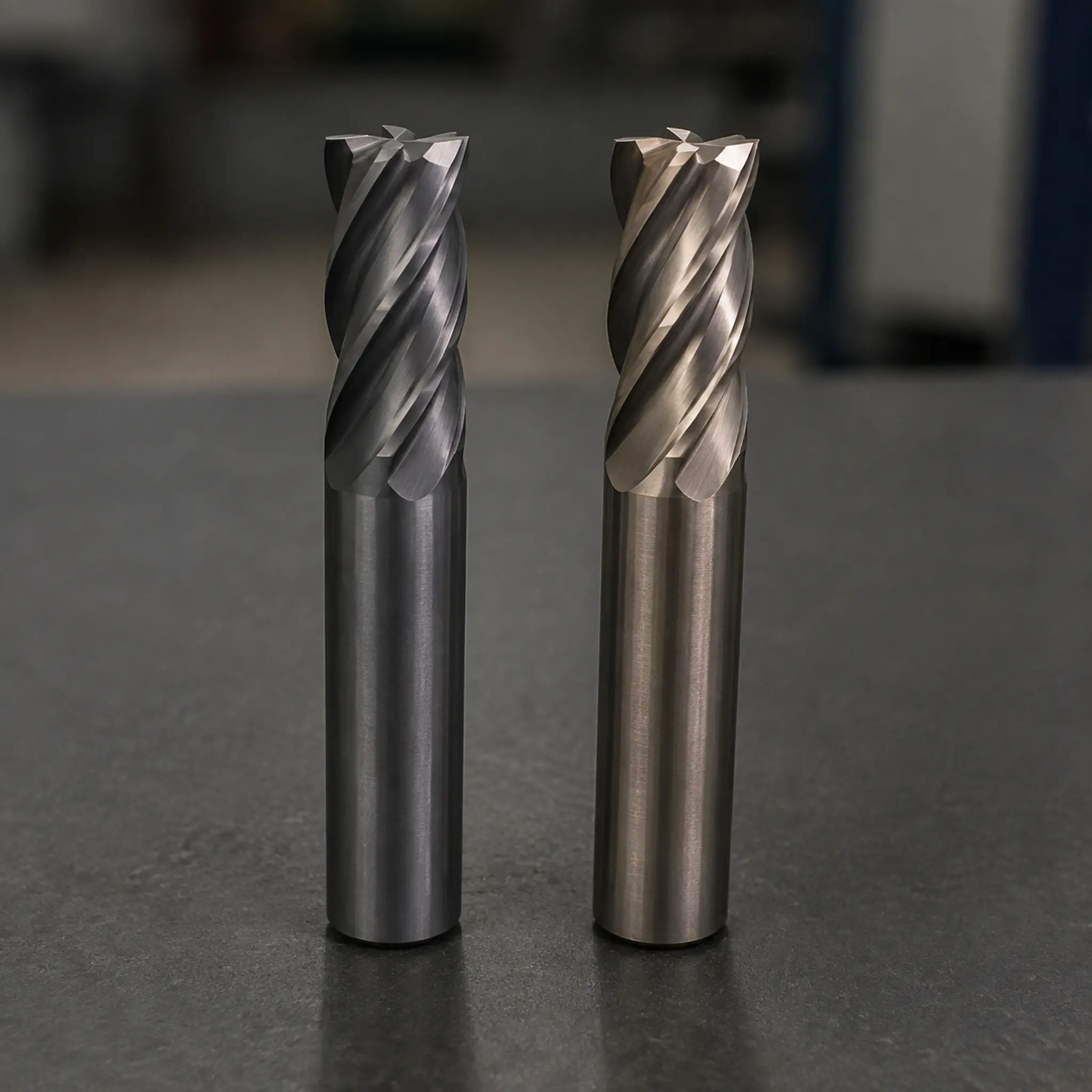
This simple answer only scratches the surface. To truly optimize your procurement and avoid costly mistakes, you need to understand why a premium tool can sometimes fail. By diagnosing the real deciding factors in your facility, you can make purchasing decisions that truly benefit your bottom line.
Why Does a "Premium" Carbide End Mill Sometimes Fail?
You made the decision to invest in premium solid carbide end mills, expecting a significant leap in performance and cycle times. Instead, you're fielding calls about frequent, catastrophic tool failures, expensive scrapped parts, and frustrated machine operators. The problem, more often than not, isn't the tool's quality but a fundamental mismatch between its properties and the machining environment.
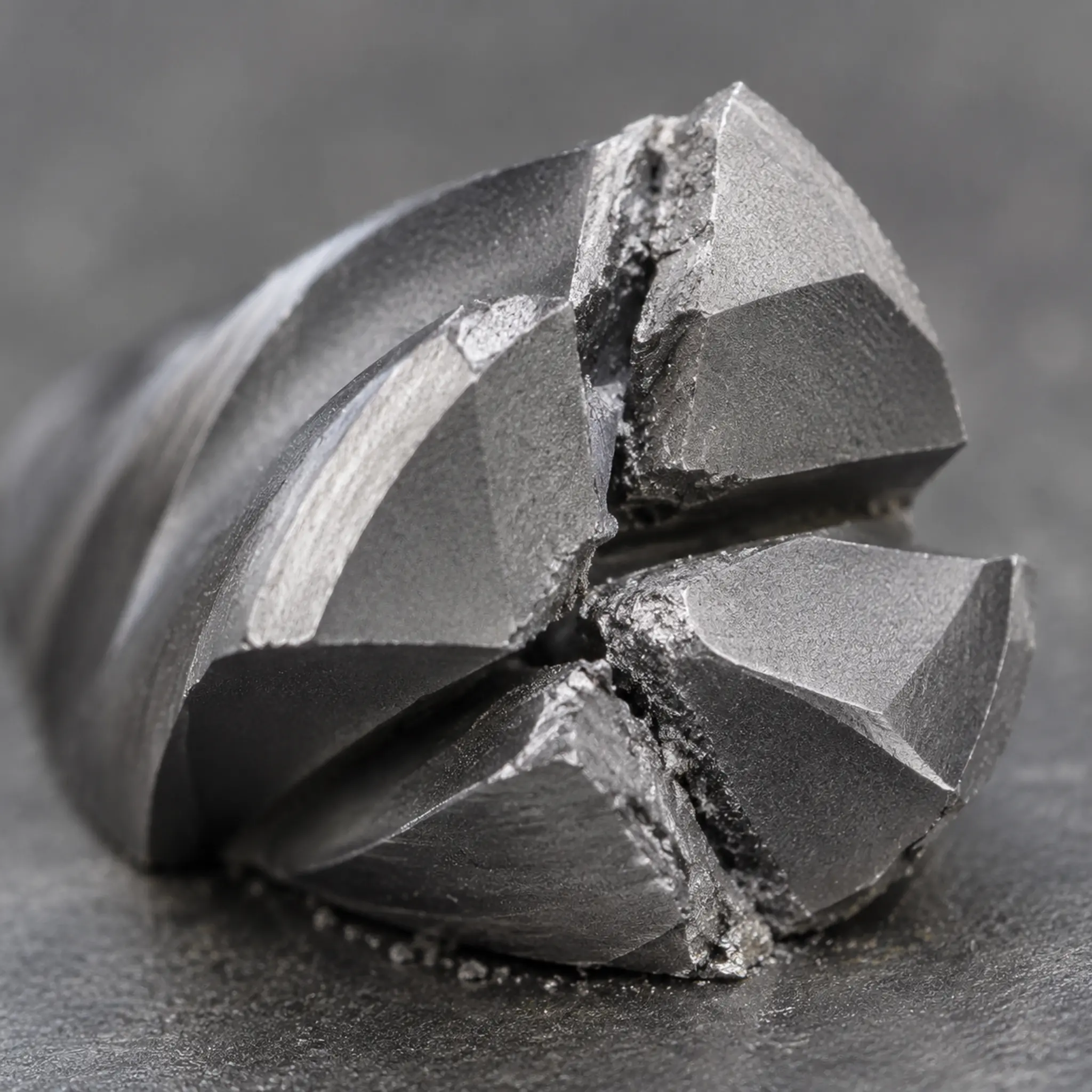
Carbide end mills are prone to failure on less-rigid machines because their extreme hardness comes with a trade-off: brittleness.[3] They cannot absorb the vibration common in older or less-stable equipment.[4] This leads to micro-chipping and eventually shattering, whereas a tougher material would simply wear down predictably.[5]
Dive Deeper: The Business Impact of a Mismatch
To make a smart purchasing decision in the carbide vs cobalt end mill discussion, we need to translate technical jargon into business risk.
Hardness vs. Toughness: A TCO Perspective
It's easy to get lost in material science, but for a procurement manager, it boils down to this:
- Hardness is the material's ability to resist wear. Solid carbide is exceptionally hard, which means it can hold a sharp cutting edge at very high temperatures and speeds.[6] This is why it enables faster cycle times. From a Total Cost of Ownership (TCO) perspective, high hardness equals longer tool life in the right conditions.
- Toughness is the material's ability to absorb energy and resist chipping or breaking under impact. Cobalt HSS is significantly tougher than carbide.%20Cutting%20Tools%20(Tool%20Geometry%20-%20Tool%20Material).pdf&stafftype=staffcourses)[7] Think of it like this: a ceramic plate (carbide) is very hard and scratch-resistant, but it will shatter if you drop it. A rubber mat (cobalt HSS) is much softer, but it will absorb the impact without breaking.
A "premium" carbide tool fails when the operational environment demands toughness that it simply doesn't have.
The Hidden Costs of a Mismatched Tool
When a carbide tool breaks, the cost is far more than just the tool itself. This is a critical risk that every purchasing manager must account for. The total cost of a single broken tool includes:
- Cost of the Tool: A premium carbide end mill can cost anywhere from $50 to several hundred dollars—a direct loss.
- Cost of a Scrapped Workpiece: This is often the biggest cost. The part being machined could be a near-complete component made from expensive material. A single tool break can turn a part worth thousands of dollars into scrap metal.
My Experience: A Customer Case Study
I recall a client, a large job shop, who called me in frustration. They were trying to be proactive, "upgrading" their entire line to our premium solid carbide tools to increase machining speeds. But their tool consumption had nearly doubled, and their emergency orders for replacements were constant.
I went to their facility to see what was happening. We walked the floor, and the issue became clear. Many of the jobs were running on older, less-rigid vertical mills. The minute the carbide tool engaged the material, you could hear the tell-tale chatter of vibration. The tools were simply too brittle for the conditions.
We diagnosed the problem wasn't tool quality, but a system mismatch. For those specific machines, we switched them back to a high-quality M42 cobalt HSS end mill. Their tool breakage dropped to almost zero, and overall throughput actually improved because they were no longer stopping production every hour to replace a shattered tool. They learned a valuable lesson in the carbide vs cobalt end mill choice: the most expensive tool is not always the most profitable one.
What's the Real Deciding Factor in the Carbide vs Cobalt End Mill Choice?
Your tool catalog is filled with speeds, feeds, and material specs, but your real-world results often don't match the promise on the page. This leaves you guessing which tool to order, feeling like you're gambling with your department's budget. The solution is to look past the tool itself, because the most critical variable isn't on the spec sheet; it's the rigidity of your entire machining system.
Machine rigidity is the single most important factor when deciding on carbide vs cobalt end mills. A rigid, stable, and low-vibration setup can fully leverage carbide's speed and heat resistance. Conversely, any machine or setup with inherent vibration requires the toughness and forgiveness of cobalt to prevent premature tool failure.
Dive Deeper: Evaluating Your Machining System
As a procurement professional, you don't need to be a machinist, but you do need to ask the right questions. Understanding the concept of "rigidity" will empower you to collaborate with your technical team and make smarter purchasing choices.
What is "Machine Rigidity"?
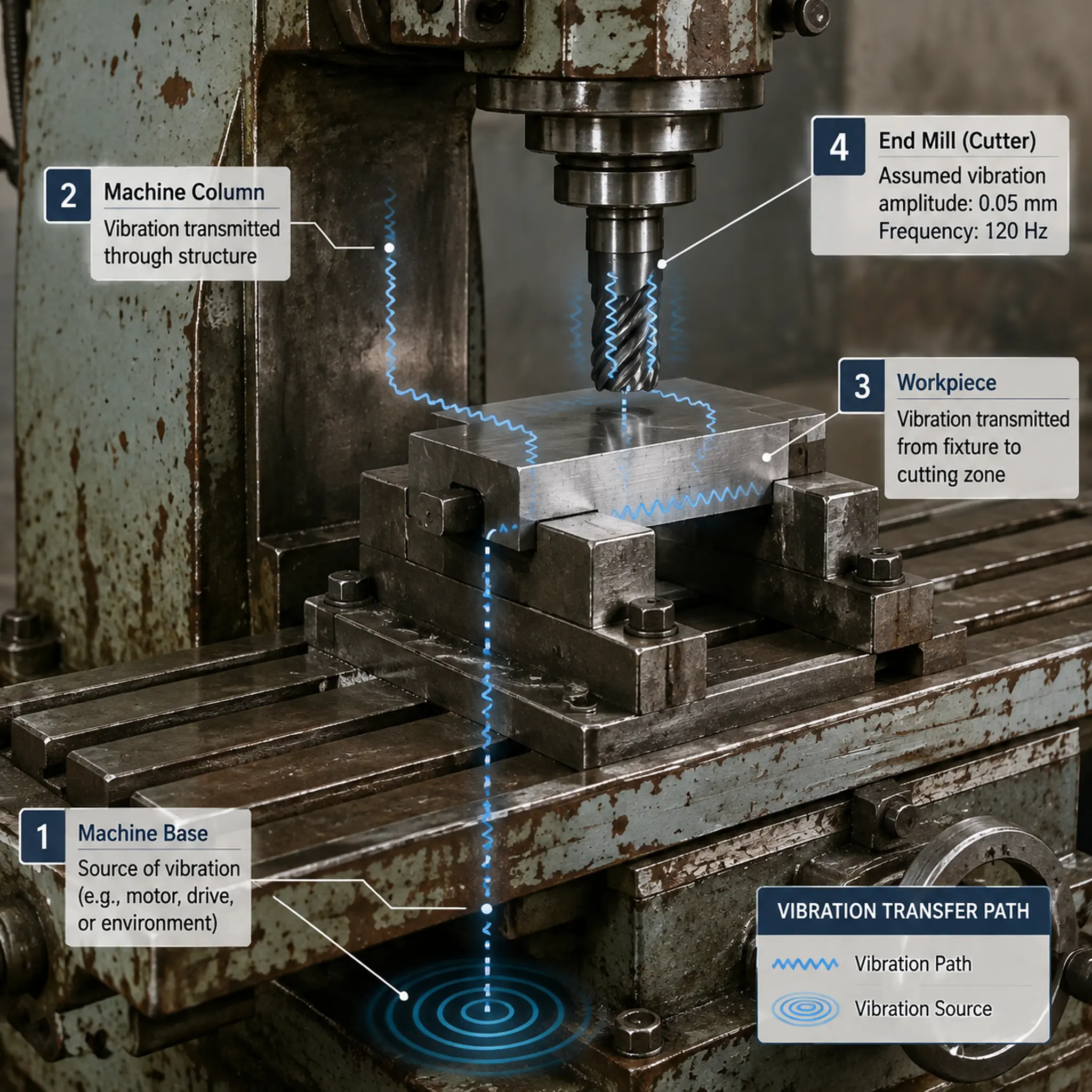
In simple terms, rigidity is the entire system's ability to resist bending, flexing, and vibrating under the immense forces of cutting metal.[10] It’s not just about the machine itself. A lack of rigidity can come from several sources:
- Machine Construction & Age: Newer, high-performance CNC machines are built with heavy, vibration-dampening frames, large linear guides, and powerful spindles. Older machines, or lighter-duty models, often have more "play" in their components (like worn ball screws or spindle bearings) that creates vibration.
- Workholding (Fixturing): If the workpiece is not clamped securely, it will vibrate during cutting, no matter how good the machine is.
- Tool Setup: The further an end mill sticks out from the holder (known as "tool overhang"), the more it will want to bend and chatter.[11] A long-reach application is inherently less rigid.
A weak link in any of these three areas can introduce enough vibration to shatter a brittle carbide tool.
A Decision Framework for Purchasing Managers
Use this table as a guide. Take these questions to your shop floor manager or lead machinist to get a clear picture of the application before you place your next tooling order. This simple checklist helps de-risk the carbide vs cobalt end mill decision.
Question for Your Technical Team | If YES, lean towards... | If NO, lean towards... | Why It Matters for Your TCO |
|---|---|---|---|
Is the machine less than 5 years old and well-maintained? | Carbide | Cobalt | Newer machines are generally more rigid and built to handle the high speeds and forces that justify carbide's cost. |
Is this a high-vibration application (e.g., long tool reach, thin walls)? | Cobalt |
1
"Alternative Binder Carbide Tools for Machining Superalloys", https://digitalcommons.calpoly.edu/cgi/viewcontent.cgi?article=1058&context=ime_fac. A university manufacturing reference describes cemented carbide cutting tools as retaining high hardness at elevated temperatures and therefore enabling higher cutting speeds than high-speed steel, particularly in rigid machine-tool systems. Evidence role: general_support; source type: education. Supports: A university or machining-text source should support that cemented carbide cutting tools maintain hardness at elevated cutting temperatures and are commonly used for high-speed machining when machine rigidity is sufficient.. Scope note: The source may support the general material-property comparison rather than the specific end-mill purchasing recommendation.
2
"Alternative Binder Carbide Tools for Machining Superalloys", https://digitalcommons.calpoly.edu/cgi/viewcontent.cgi?article=1058&context=ime_fac. Manufacturing engineering texts commonly distinguish high-speed steel from cemented carbide by noting that HSS grades have greater toughness and resistance to shock, while carbide offers higher hot hardness and wear resistance. Evidence role: general_support; source type: education. Supports: A manufacturing or machining source should support that high-speed steel, including cobalt-alloy HSS, has higher toughness than carbide and is often used where shock, vibration, or interrupted cutting is present.. Scope note: The source would provide contextual support for the material-selection principle, not direct evidence that cobalt HSS is always the most cost-effective option.
3
"Advanced characterization techniques in cemented carbides", https://upcommons.upc.edu/bitstreams/757ac7e7-6c0a-4ca2-bcbe-e9a31484a18f/download. Research on cemented carbide cutting tools notes that their high hardness and wear resistance are accompanied by comparatively limited fracture toughness, which can lead to chipping or brittle fracture under impact or vibration. Evidence role: mechanism; source type: research. Supports: A technical source should explain that cemented carbide has high hardness and compressive strength but lower fracture toughness than HSS, making it susceptible to chipping or fracture under vibration or impact.. Scope note: The source may discuss carbide tools generally rather than end mills specifically.
4
"[PDF] An Investigation of Cutting Tool Chatter Vibration in Machine Tools", https://scholarworks.uni.edu/cgi/viewcontent.cgi?article=4664&context=grp. Machining-dynamics studies show that chatter and vibration impose fluctuating cutting forces that increase cutting-edge damage, with brittle tool materials being more susceptible to chipping and fracture. Evidence role: mechanism; source type: paper. Supports: A peer-reviewed paper on machining chatter or cutting-tool failure should support that vibration increases dynamic loads at the cutting edge and can accelerate chipping or fracture in brittle tool materials.. Scope note: Such studies may not compare every carbide and cobalt HSS grade directly.
5
"Micro Vibration in Machining", https://www.secotools.com/article/micro_vibration_in_machining?language=en. Experimental studies of cemented-carbide tool wear identify edge chipping and micro-fracture as common failure modes under unstable cutting loads, distinct from gradual flank or crater wear mechanisms. Evidence role: mechanism; source type: paper. Supports: A research paper should support that carbide cutting tools may fail through edge chipping, micro-fracture, or brittle fracture under unstable cutting conditions.. Scope note: The source may document the failure mode without proving that a specific cobalt HSS tool would wear predictably in the same operation.
6
"Tailoring Primary Carbide Architecture of High-speed ...", https://ui.adsabs.harvard.edu/abs/2024BHM...169..147N/abstract. Manufacturing texts describe hot hardness as a key property of cutting-tool materials and identify cemented carbides as retaining hardness and cutting ability at higher temperatures than high-speed steels. Evidence role: mechanism; source type: education. Supports: A manufacturing education source should support that cemented carbide has higher hot hardness than HSS and retains cutting ability at higher speeds and temperatures..
7
"Foliengestaltung mit PowerPoint 2000/2003", https://aast.edu/pheed/staffadminview/pdf_retreive.php?url=67_31085_IM212_2017_1__1_1_10)%20Cutting%20Tools%20(Tool%20Geometry%20-%20Tool%20Material).pdf&stafftype=staffcourses. Cutting-tool material references generally classify high-speed steels as tougher and less brittle than cemented carbides, while carbides are harder and more wear-resistant. Evidence role: definition; source type: education. Supports: A machining or materials source should support the distinction that HSS grades are generally tougher and less brittle than cemented carbide cutting tools.. Scope note: The comparison is grade-dependent; individual carbide and HSS formulations can vary.
8
"Potential Cost Savings as US Manufacturers Spend ...", https://www.nist.gov/news-events/news/2021/06/potential-cost-savings-us-manufacturers-spend-billions-machinery. Manufacturing productivity studies treat machine downtime as a measurable economic loss because it reduces equipment availability, labor utilization, and production throughput. Evidence role: general_support; source type: government. Supports: A government or institutional manufacturing study should support that downtime affects productivity and has measurable economic costs in manufacturing operations.. Scope note: The source would support the general cost mechanism rather than quantify downtime cost for the specific shop described.
9
"What is Tool Runout? Causes, Effects & Proven Solutions - ZYsuperhard", https://zydiamondtools.com/tool-runout-explained-causes-effects-on-tool-life-and-proven-solutions/. Machine-tool maintenance literature recognizes severe tool-breakage events as a source of secondary damage, including damage to workholding, toolholding, workpieces, and in some cases spindle assemblies. Evidence role: general_support; source type: research. Supports: A technical or maintenance source should support that tool breakage events can cause secondary damage to workpieces, holders, spindles, or machine components.. Scope note: The likelihood and severity of spindle damage depend on machine design, cutting conditions, and the nature of the breakage.
10
"Force and deflection modelling in milling of low-rigidity ...", https://www.academia.edu/13118673/Force_and_deflection_modelling_in_milling_of_low_rigidity_complex_parts. Manufacturing engineering texts define machine-tool stiffness or rigidity as the resistance of the machine-fixture-tool-workpiece system to displacement and vibration under cutting loads. Evidence role: definition; source type: education. Supports: A manufacturing engineering source should define machine-tool rigidity or stiffness as resistance to displacement, deflection, and vibration under applied cutting forces..
11
"Investigation of Tool Overhang Length Effects on Machining ...", https://www.academia.edu/103581536/Investigation_of_Tool_Overhang_Length_Effects_on_Machining_Responses_During_Turning_Operation. Machining-dynamics research shows that increased tool overhang lowers tool stiffness and can reduce chatter stability, thereby increasing deflection and vibration during milling. Evidence role: mechanism; source type: paper. Supports: A machining dynamics paper should support that increasing tool overhang reduces dynamic stiffness and increases susceptibility to deflection and chatter..